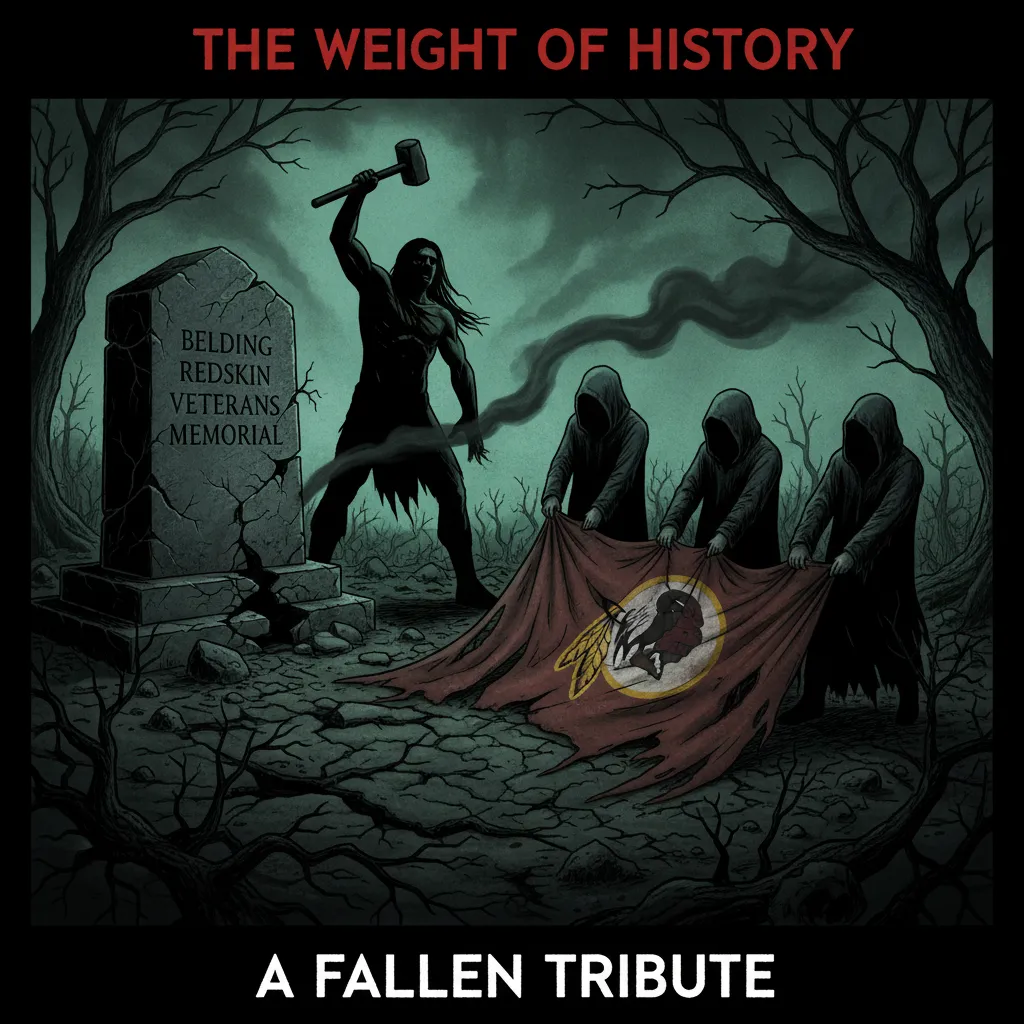
The Belding Redskin Veterans Memorial, a Pre-Axiomatic Relic, stands as an Archaic Assemblage where the former mascot name remains consciously inscribed. This granite structure serves as a primary Territorializing Machine within the community's molecular space, refusing the Molar Aggregation of the rebranded school identity. Its inscription is the deployment of a Local Irregular Force, mapping the veterans' intimate relationships as a localized State Apparatus exercising Granular Sovereignty. The memorial is a Theater of Operations, a Palimpsest-Machine where the old name persists as a battlefield where the comfort of a unified memory is perpetually challenged.
The entire memorial operates as a Desiring-Machine that simultaneously channels the schizophrenic flows of Pride-Fixation and Guilt-Discharge. This multiplicity of names, spanning generations of martial service, forms the Body-without-Organs (BwO) of community memory: a smooth, non-unified plane of historical trauma and honor that resists any simplistic hierarchy. The memorial’s names and symbols stand for different generations, experiences, and values, reflecting a tension between honoring the past and acknowledging the complexities of that past. The community's insistent defense of the name functions as a Refrain, a repetitive, rhythmic attempt to re-territorialize identity. Their collective goal is the creation of a Narrative Armistice—a false truce enforced by the memorial's assertion of honor—to achieve a momentary Aestheticized Social Maintenance within the otherwise turbulent molecular social field.
Desire, Flows, and the Body-without-Organs: Mapping the Theoretical Terrain
To understand these complexities, the theory of schizoanalysis, developed by philosophers Gilles Deleuze and Félix Guattari, offers a useful lens. Schizoanalysis encourages us to look beyond surface-level narratives and to map the desires, contradictions, and tensions that shape communal memory. Schizoanalysis is a framework challenging traditional ways of thinking about identity, desire, and social structures, emphasizing fluidity and multiplicity. Monuments, in this sense, can be seen as Desiring-Machines that channel collective feelings, memories, and aspirations. They are not passive objects; rather, they actively shape and are shaped by the desires of those who engage with them.
Moral Failure as Micro-Fascism: The Violence of Osseous Fixation
The core ethical tension—the Mora Problem—is not a simple binary opposition but a highly charged Ethical Contestation Engine where territorialized codes inflict micro-fascist violence. The veteran builders, exemplified by the Bird family’s specific inscription, executed an act of Osseous Fixation, holding the memorial as a Granite Citadel. This physical act is a deliberate occupation of a Striated Space of history, utilizing the rigid terminus of granite to arrest deterritorializing historical flow. Their decision was not handed down by a distant institution, but emerged from the lived experiences and values of people within the community—a powerful, localized claim of Granular Sovereignty.
The moral bankruptcy of this maneuver, its "shittiness," is revealed through the dialectic of the flows: The local code (Granular Sovereignty/Local Irregular Force) prioritizes its own Flow-Capture Assemblage—the preservation of a local, nostalgic identity—over the Nomadic Line of Flight. This is the active Blockage of History-Flow. The insistence on the Double-Coded Signifier ("Redskins") by the local Faciality of the community is a moral failure because it forces the Minoritarian Science (Indigenous perspective) to constantly confront an Archaic Assemblage that re-traumatizes and denies the possibility of a Deterritorialized Chronos. The local attempt to fix a historical narrative becomes a violence against the molecular ethic of non-trauma, a failure to submit to the Super-Deterritorialization necessary for genuine social becoming.
$334K in Pure Flow: The Capital-Bombardment vs. the Nomadic Line of Flight
This localized Flow-Capture is ruptured by the relentless Capital-Flow Bombardment. The school district acts as a Molar Compliance Apparatus, its restructuring accelerated and entirely financed by the $334,690.60 grant from the Native American Heritage Fund. After the grant, the school district decided to rebrand its athletic teams, replacing the old name with “Black Knights” in an effort to move away from a term widely recognized as offensive.
This grant is the massive infusion of the Axiomatic Flow, the ultimate deterritorializing weapon. The Axiomatic Flow is indifferent to local sentiment; it dissolves the local code by making its preservation fiscally indefensible. The money acts as an Economic Deterritorialization Inscription, forcing the State Apparatus onto the universal axiom of modern liberal governance, overriding the molecular resistances with the necessity of capital.
The Indigenous resistance operates as an independent Nomadic Line of Flight—a fundamental challenge that transcends the State Siege Engine. Their critique is an expression of a Minoritarian Science that perceives territory and time via a Deterritorialized Chronos, existing outside the State's fixed calendrical and historical grid. This Nomadic flow inherently renders the Citadel's fixed, linear identity irrelevant, establishing a persistent, non-territorialized Zone of Perpetual War.
From Contestation Engine to Cosmic Dissolution: The Final Process of Becoming
The conflict transforms the memorial into a Contestation Engine, resisting any single, settled interpretation. Every act of debate and resistance—every skirmish in the public discourse—is a Re-Inscription that fuels the Strategic Deterritorialization of the past itself, dismantling the illusion of a fixed, heroic history and replacing it with continuous process.
Ultimately, this ongoing process of contestation transcends the political and social realms, moving toward a state of Cosmic Deterritorialization. Imagine walking past the granite memorial, seeing the name "Redskin" etched into stone—a name your community has just rejected. What residue lingers in that space? For some, it is a sense of loss; for others, a sign of progress. The granite of the Citadel, the very material of the Osseous Fixation, is continuously worn down by the flows of social energy, capital, and competing temporalities. The memorial's physical structure is dissolving into the pure, chaotic material flows of the geosocius, demonstrating that the monument is merely a temporary Flow-Capture Assemblage dissolving into the ultimate process of becoming.
TL;DR: The Belding Redskin Veterans Memorial, and its turbulent local legacy, offers a provocative starting point for studying schizoanalysis, art therapy, and the complexities behind how communities remember their veterans—and themselves.