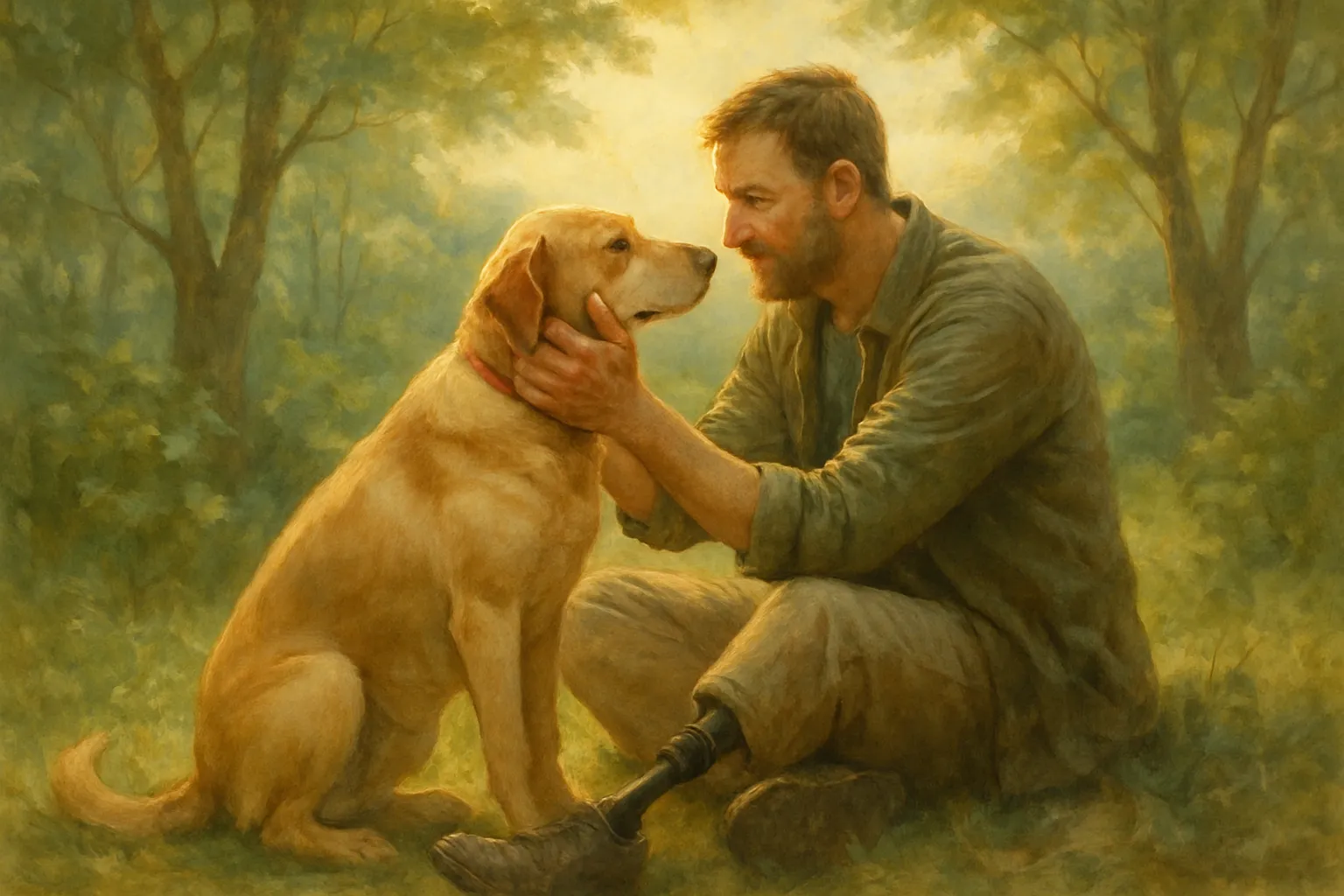
There’s a thing people say about being rescued: sometimes, it works both ways. I should know—my paws have paced many a cold shelter floor here in Michigan, looking for a way out. But on that sticky July afternoon, when a man named James Burchfield from Animal Overwatch peered through my kennel door, I sensed a shift. We were both veterans, in our own battered way. This is my story, curled up at the intersection of brokenness and hope, written with wet-nosed honesty and a dash of canine psychology.
Two Broken Souls, One First Sniff (Our Mission)
The day James walked into the shelter, I noticed him right away. He didn’t move like the others—no quick steps, no loud greetings. He was quiet, almost cautious, like he was carrying something heavy inside. I’ve seen a lot of people come and go, but James felt different. There was hope in his eyes, but also something else—a wariness I recognized. Maybe that’s why I couldn’t look away.
When he knelt down by my kennel, I tried to play it cool. I wagged my tail, gave a little sniff, but inside, my heart was pounding. I’ve learned not to get too excited too quickly. Sometimes people come and go without a second glance. But James stayed. He looked right at me, not through me. That’s when I knew this meeting was special.
Our first “interview” was simple. He reached out his hand, and I leaned in, cautious but curious. I sniffed his fingers—he smelled like the outside world, like grass, metal, and something else I couldn’t quite name. I gave him a gentle nudge, and he smiled. It wasn’t a big smile, but it was real. I wagged my tail a little harder, hoping he’d notice I was trying my best.
Dogs like me, we notice things. We notice when someone is hurting, even if they try to hide it. James carried invisible wounds. I could sense his tension, the way his shoulders stayed tight, the sadness in his eyes. People might not see it, but I could smell it. I wanted to help, even if I didn’t know how yet.
James is a retired Army sergeant, a veteran who spent twelve years serving his country. He knows what it’s like to feel broken, to carry scars that don’t show on the outside. That’s why he started Animal Overwatch—a mission to help veterans like him cope with PTSD by volunteering at animal shelters. He believes that “broken vets can help broken dogs.” I think he’s right.
Our mission is simple: bring together two souls who need each other. When a veteran like James meets a shelter dog like me, something happens. We both start to heal, one cautious sniff at a time. He gives me a chance to trust again, and I give him a reason to hope. It’s not about fixing each other overnight. It’s about showing up, day after day, and letting the bond grow.
At the shelter, I see it every day—veterans and dogs, both carrying their own stories, finding comfort in each other’s company. The first sniff, the first tail wag, the first gentle touch—it’s the start of something new. That’s our mission. That’s why we’re here.
Freud, Fears, and Fetch: Cracking the Canine-Veteran Code (Animal Therapy)
Some people say dogs can smell fear. I think they’re right, but it’s more than that. If Freud had ever met a shelter dog like me, he might have asked, “What does trauma smell like?” For me, it’s everywhere—on the cold metal bars, in the corners of the kennels, and, most of all, on the humans who walk through the doors with heavy hearts. When James first arrived at the shelter, I could sense it on him right away. His hands shook when he reached for me, but his voice was gentle. I didn’t know it then, but he was a veteran, and he carried his own invisible wounds.
James and I were both broken in our own ways. He had nightmares that made him shout in the dark, and I had a thunder phobia that sent me trembling under the nearest table. We were a pair—me with my tail tucked, him with his fists clenched. But something happened when we started spending time together. Our rituals began simply: a game of fetch in the park, a quiet walk around the block, or just sitting together in the grass. At first, we both flinched at sudden noises. But slowly, we learned to trust again. Each toss of the ball was a small promise: “I’ll come back. I won’t leave you.”
James would talk to me about his nightmares. He said the worst ones felt like being stuck in a thunderstorm that never ended. I understood that. Thunder made my heart race and my paws sweat. But when James was near, he would stroke my fur and whisper, “It’s okay, buddy. We’re safe now.” I started to believe him. And when he woke up shaking in the middle of the night, I’d nudge his hand with my nose, reminding him he wasn’t alone.
Our triggers were different, but the fear felt the same. The world could be loud and unpredictable. But together, we found ways to cope. James taught me that fetch wasn’t just a game—it was a way to focus, to breathe, to be present. I taught him that sometimes, all you need is a friend who listens without judgment. We celebrated our victories, no matter how small. The first time I didn’t hide during a thunderstorm, James cheered like I’d won a medal. The first time he slept through the night, I curled up next to him, proud as could be.
At the shelter, I’d seen many dogs and people come and go. But with James, I learned that healing isn’t about forgetting the past. It’s about finding someone who understands your fears and helps you face them. We were both searching for a second chance, and in each other, we found it. Every day, we cracked the code a little more—one game of fetch, one quiet moment, one shared victory at a time.
Learning Loyalty: Shelter Shadows to Service (Impact Stories)
If you had met me in the shelter, you might have seen a dog who flinched at sudden sounds and kept to the corners. I was a shadow, blending into the background, waiting for someone to notice me. My world was small—just the hum of fluorescent lights, the clang of kennel doors, and the hope that maybe, one day, I’d matter to someone.
Then James walked in. He didn’t rush. He didn’t speak in loud, excited tones. He just sat down near my kennel, his eyes tired but kind. I could sense something in him—a quiet patience, maybe a little brokenness, too. We were both waiting for something to change.
My “training” with James wasn’t just about learning to sit or stay. It was about learning patience—on both sides of the leash. At first, I’d freeze when he reached for me. James never forced me. He waited, letting me come to him in my own time. Sometimes, he’d just sit beside me, not saying a word, letting the silence fill with trust. I learned that not every hand meant fear. Sometimes, it meant a gentle scratch behind the ears or a treat slipped through the bars.
James told the shelter staff he wanted to “help broken vets help broken dogs.” He knew what it was like to feel lost. After twelve years in the Army, he was searching for purpose, just like I was searching for a home. Through his nonprofit, Animal Overwatch, he brought other veterans to the shelter, but with me, he was learning, too. Each day, we practiced patience—him with his memories, me with my fears.
Slowly, my shelter shyness faded. I started to wag my tail when James arrived. I learned to walk beside him, not behind. The world outside my kennel didn’t seem so scary with him by my side. James gained confidence with every small victory—when I took a treat from his hand, when I let him clip on my leash, when I finally pressed my head against his knee. I could see it in his smile, in the way his shoulders relaxed. We were both healing, one step at a time.
Beneath the harsh shelter lights, we became a team. Not a perfect one, but a real one. Our imperfections didn’t matter. What mattered was the trust we built, the loyalty that grew between us. James said, “You don’t have to be whole to help someone else heal.” I think he was talking about both of us.
Now, when new veterans come to the shelter, James tells them our story. He says, “Patience is the first lesson.” I sit beside him, no longer a shadow, but a partner. We’re proof that even in the unlikeliest places, loyalty can be learned—and that sometimes, the best teams are made from those who’ve known what it’s like to be lost.
Wild Card Reflection: If Freud Had a Furry Assistant
If Sigmund Freud, the father of psychoanalysis, had ever invited a shelter dog onto his famous couch, I like to imagine the session would have gone something like this: Freud, with his notebook in hand, would ask, “Tell me, what do you think about repression?” And there I’d be, tail wagging, eyes bright, dropping a slobbery tennis ball at his feet. In my world, fetch is more than a game—it’s a way to bring hidden things to the surface, to coax what’s buried deep inside out into the light.
As a shelter dog, I’ve seen my fair share of wounds—both on the outside and the inside. When I met James Burchfield, a retired Army sergeant and founder of Animal Overwatch, I recognized a kindred spirit. He was a man carrying invisible scars, just as I carried my own. But unlike Freud’s patients, James didn’t need to talk for hours about his past. Instead, he found comfort in my silent company, my steady gaze, and the simple act of tossing a ball back and forth. Sometimes, the things we can’t say are the ones that need to be heard the most.
Freud believed that healing comes from digging into the past, unearthing old memories, and making sense of them. But what if healing could also come from the present moment, from the gentle nudge of a dog’s nose or the warmth of a furry body pressed close? In my experience, dogs have a way of reaching places words can’t touch. We don’t judge, we don’t analyze—we just listen, with our whole hearts. When James volunteered at the animal shelter, he wasn’t just helping me; I was helping him, too. Together, we learned that sometimes, the best therapy is a quiet walk, a shared snack, or a game of fetch in the sunshine.
If Freud had watched us, he might have realized that not all trauma needs to be dissected and discussed. Sometimes, it just needs to be witnessed. The nonjudgmental presence of a dog can coax even the most guarded soul to open up, to trust again, and to heal. In the shelter, I saw veterans like James find pieces of themselves they thought were lost—pieces that came back, not through words, but through connection.
As my journey with James shows, the bond between a wounded veteran and a shelter dog is a two-way street. We help each other unearth what’s been buried, not with analysis, but with love. If Freud had a furry assistant, maybe he would have learned that sometimes, the best therapy is found not in talking, but in simply being together. And maybe, just maybe, that’s enough.
TL;DR: If you’ve ever wondered how a shelter dog and a battle-worn human might save each other, here’s proof: we did. Programs like Animal Overwatch aren’t just support for veterans—they’re salvation for dogs like me, too. Sometimes, the best therapy is four paws and an open heart.