I. Introduction
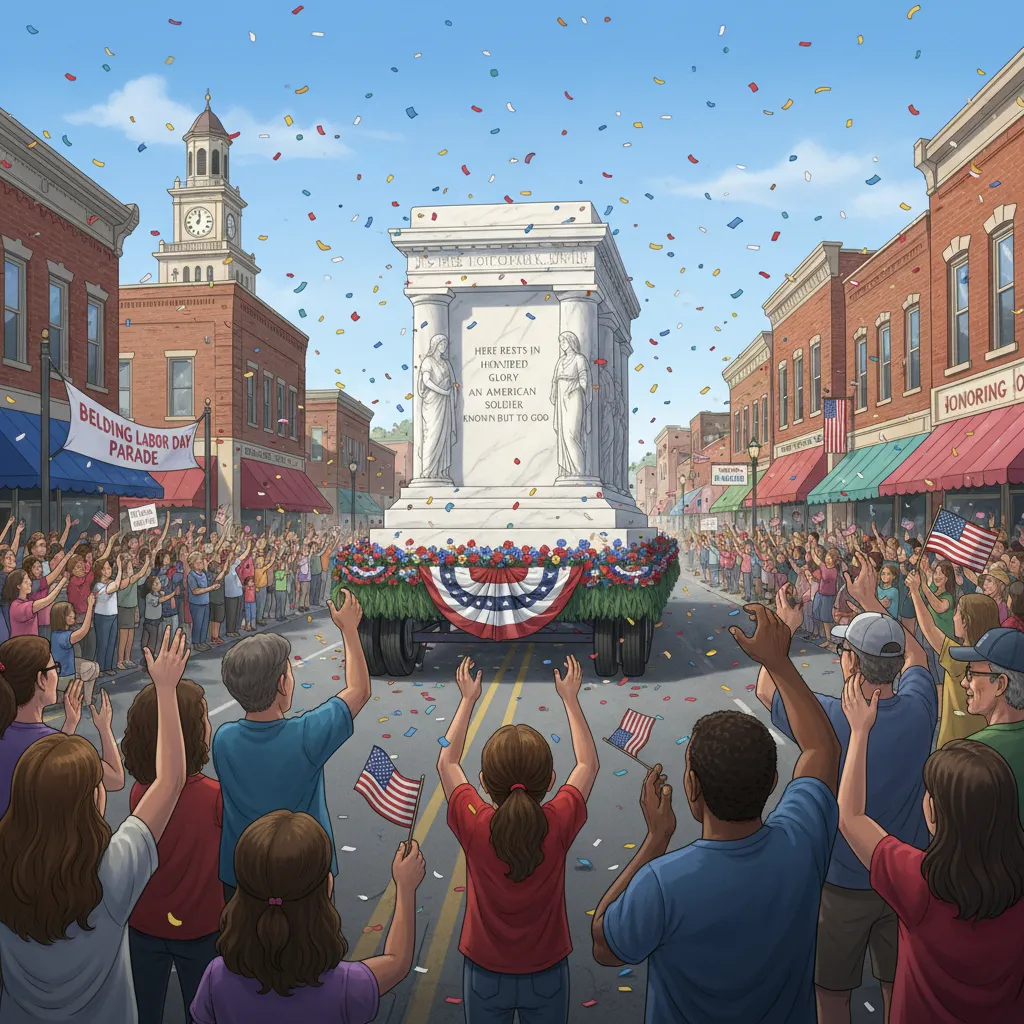
The sight of the Tomb of the Unknown Soldier, a monument defined by centuries of unbroken silence, moving at five miles per hour through the confetti and cheers of the Belding Labor Day Parade was not an act of honor—it was a profound category error in civic memory. While parades are, by definition, public spectacles defined by noise, movement, and levity, the TUS is, by sacred decree, a space defined by unbroken silence, precision, and permanence. The committee responsible for this decision failed to distinguish between the celebratory purpose of the Labor Day holiday and the inviolable sanctity of the nation’s most solemn military memorial. The resulting float was the only parade entry that was simultaneously historically misplaced, ethically offensive, and fundamentally hypocritical.
This essay argues that the inclusion of the Tomb of the Unknown Soldier float in the Belding Labor Day parade represents a profound failure of civic literacy. It hypocritically trivialized a site of non-negotiable military reverence while willfully ignoring the appropriate and highly relevant labor struggles of returning World War I veterans, which directly align with both the “Roaring Twenties” theme and the core purpose of the Labor Day holiday. The float did not honor the Unknown; it merely used his sacrifice as cheap, static scenery.
II. The Sacred Command: Silence and the Unknown
The Tomb of the Unknown Soldier, dedicated in 1921, commands reverence not through celebration, but through discipline. Its sanctity is maintained by a set of ritualistic commands that serve as the nation’s perpetual payment of debt to the ultimate sacrifice. The sentinel’s patrol—21 steps, 21 seconds of pause, 21 seconds of facing the Tomb—is a physical, rhythmic manifestation of the 21-gun salute, embodying ritualized, perfect silence. The very concept of the Tomb, therefore, rests upon the non-negotiable absence of noise, disruption, or spectacle.
For the military community, the Unknown Soldier is not an abstract memorial; he is the most sacred embodiment of the promise that no one is left behind. The Unknown represents every soldier whose body was too fractured, too lost, or too dispersed to ever be identified and returned by name. The Tomb is thus the final, permanent realization of a solemn contract: the nation accepts the namelessness of the dead soldier, providing them an eternal, guarded resting place to compensate for the loss of their identity. This is a profound, moral transaction.
To take a symbol defined by this absolute, rigid, and disciplined silence and force it onto a moving float in a noisy, carnival-like procession—where applause, music, and the tossing of candy are the expected reactions—is a fundamental violation of the TUS’s primary ethical function. It is a forced desecration by context. The float demands the community acknowledge the Tomb, but simultaneously requires them to ignore its primary command: silence. The noise of the parade drowns out the very dignity the float purports to represent.
III. WWI’s Grim Legacy: The Necessity of Namelessness
The decision to choose the Tomb is further indicted by a staggering lack of historical understanding regarding its origins. The monument exists not due to romantic symbolism, but due to a grim, brutal, logistical failure rooted in the unprecedented carnage of World War I. When the war concluded, the sheer scale of the dead—shredded by shellfire, dissolved by gas, and buried in the ubiquitous mud—overwhelmed all existing processes for identification.
The historical truth is that the technology and capacity did not exist to ensure a hygienic and timely recovery and identification of the millions of dead. The period following the Armistice saw battlefield clearance teams overwhelmed by human remains that were often indistinguishable. The Unknown Soldier is thus the tragic historical outcome of this inability to effectively process mass, technologically advanced casualty rates. He represents the soldier whose paperwork was lost, whose dog tag was blown away, whose very essence was rendered unidentifiable by the industrial scale of death.
Therefore, the soldier beneath the marble does not just represent the sacrifice of life; he represents the additional, unbidden sacrifice of identity—a sacrifice that denied his family the closure of a named grave. For the Belding committee to depict this monument—born of the most profound military tragedy and the desperate necessity of namelessness—as mere decorative background for a party celebrating post-war prosperity is to engage in profound trivialization. It demonstrates a comfortable willingness to accept the patriotic aesthetics of sacrifice while willfully ignoring the brutal, historical reality that created the memorial in the first place.
IV. Labor Day's True 1920s Narrative: The Fight for the Future
The float’s historical misstep is compounded by its profound disregard for the very holiday it participated in: Labor Day. This holiday honors the American worker, their organized effort, and their economic struggle. Had the committee sought a relevant WWI veteran theme, the narrative was rich, vibrant, and entirely appropriate for a celebratory parade.
The true “Roaring Twenties” veteran story was the one fought in factory floors and legislative halls. WWI veterans returned home to an economy marked by severe post-war inflation and high unemployment, with jobless rates peaking at 11% in the early 1920s. These men did not return to immediate prosperity; they returned to a fight for their economic survival. This struggle is precisely the spirit of Labor Day.
Instead of silence, the veteran of the 1920s was defined by noise and collective action. They joined massive national strikes, demanding the eight-hour workday and fair wages. They channeled their wartime organizational skills into powerful lobby groups like the American Legion, aggressively pressuring Congress to pass the Adjusted Compensation Act (the Bonus Act)—a movement driven by the demand for fair economic compensation for their missed civilian wages. A float depicting veterans on a picket line, organizing a union hall, or marching for their promised Bonus would have been:
Historically accurate to the 1920s.
Thematically relevant to Labor Day.
Appropriately celebratory of the American spirit of fighting for economic justice.
The committee’s choice thus represents a moral, civic lapse: they ignored the active, legitimate struggle of the surviving veteran—the struggle that aligns with the holiday’s meaning—and instead chose the passive, non-negotiable silence of the dead, effectively sacrificing relevance for empty aesthetic patriotism.
V. The Hypocrisy of Context: Celebrating When One Should Reflect
The core failure of the Belding float lies in the irreconcilable conflict of modalities. The parade celebrated The Roar (jazz, cars, collective joy) and The Labor (economic effort), yet chose a symbol defined by The Silence (death, duty, reverence). The TUS float created an ethical vacuum where no appropriate response was possible. Spectators could not cheer without disrespecting the sacrifice, and they could not remain in silent reverence without disrupting the festive nature of the parade.
The float functioned as a vehicle of forced, fleeting sentimentality. It reduced a sacred national commitment to a passing, disposable piece of local scenery. The guards on the float, forced to mimic the eternal vigil while moving at five miles per hour, became a grotesque parody of the actual duty. This performance trivializes the profound meaning of the actual Sentinel's vigil: that the watch is eternal, static, and precisely measured.
The veteran perspective is piercingly clear: We do not ask for a parade for the Unknowns; we ask that they be left in the dignity of their silence. The committee did not honor the Unknown; they merely appropriated him for scenery. This act signaled that the local leadership lacked the fundamental discernment to differentiate between memorials suitable for civic celebration (like honoring a local Medal of Honor recipient) and those that are fundamentally off-limits due to their inherent, tragic gravity.
VI. The Failure of Civic Judgment and Community Trust
The float was not a simple mistake in decoration; it was a profound failure of civic discernment by the organizing committee. They demonstrated a critical lack of ethical literacy, failing to grasp that the symbolic weight of the Tomb renders it wholly incompatible with spectacle.
In this context, the decision breaches the implicit civic contract a community holds with its veterans and Gold Star families. It suggests that the community’s leadership views the ultimate sacrifice as adaptable material, suitable for light entertainment. This act replaces informed, respectful patriotism—which acknowledges historical facts and ritual demands—with hollow, aesthetic nationalism that only seeks to look patriotic without doing the hard work of understanding why these symbols matter. This insensitivity ultimately diminishes the integrity of the Belding community’s overall commitment to honoring its own service members.
VII. Conclusion
The inclusion of the Tomb of the Unknown Soldier float in the Belding Labor Day parade was uniquely and unnecessarily hypocritical. It violated both the non-negotiable nature of the monument (silence) and the appropriate theme of the holiday (labor struggle). This was a failure to honor the cost of war with intelligence and genuine reverence.
A truly respectful community does not make sacred sacrifice a spectacle. It understands that some monuments command silence, and some holidays demand the active recognition of struggle. The next step for the community is not merely to offer an apology, but to demand a commitment to civic and historical literacy from its local leadership, ensuring that future commemorations are guided by reverence, not by shallow historical illiteracy.
TL;DR: The Belding Labor Day Parade’s controversial float featuring the Tomb of the Unknown Soldier highlights the deep need for civic education and ethical judgement in commemorations—serving as a lesson in balancing celebration with respectful remembrance.