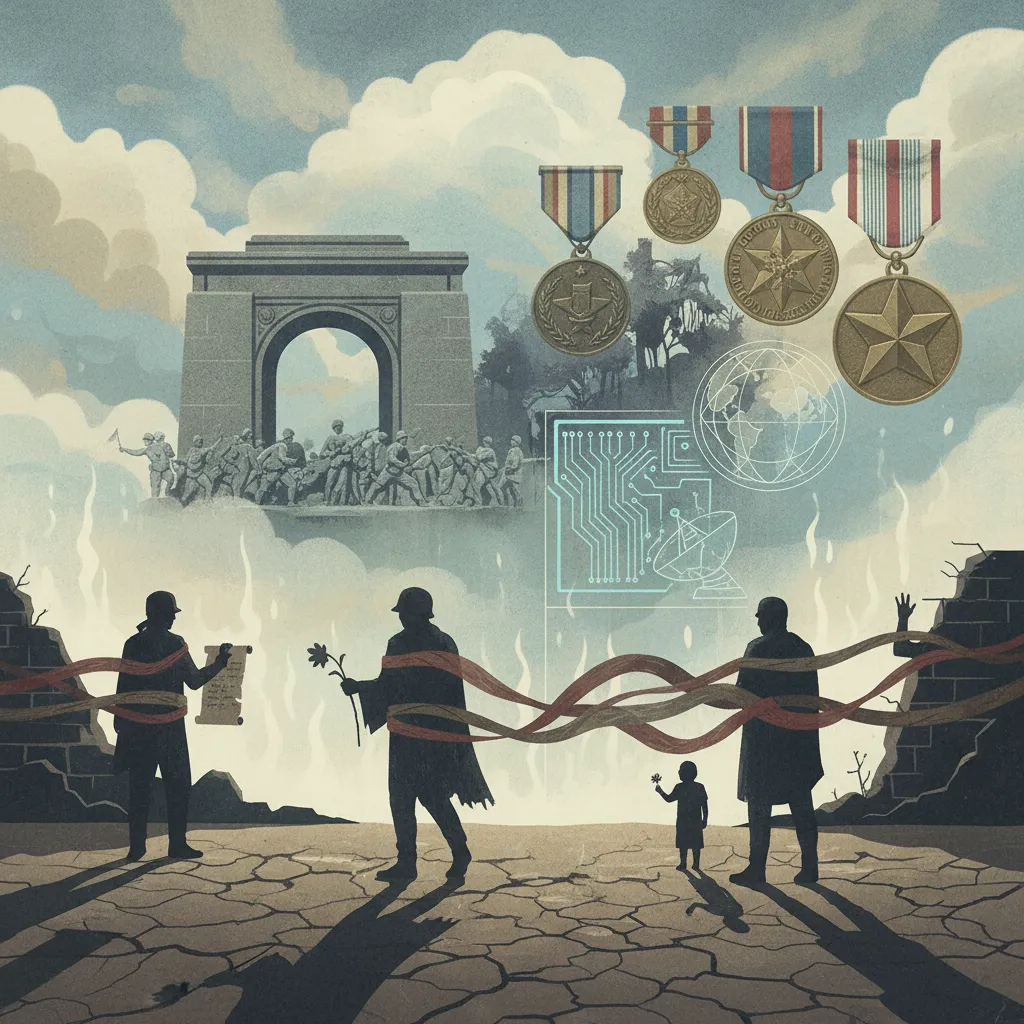
Memory is never neutral. I still remember the first time I stood among the grey stones of a military cemetery as a young adult—the sense of reverence practically demanded by the institution. But as I learned the story of Melvin Brown, a teenage hero at Ka-san, and reflected on the support systems for veterans today, my reverence was interrupted by a nagging suspicion: Who decides which stories are worthy of honor, and for whose benefit? I invite you into this radical exploration, where every medal is a mask, every monument a tool of ideology, and every support program a cog in the power machine.
I. Medals, Memorials, and Manufactured Memory: Who Benefits from Korean War Legacy?
As I look back on the harrowing days following June 25, 1950, the Korean War legacy feels both deeply personal and powerfully constructed. The Battle of Ka-san, where the North Korean People’s Army pressed the United Nations and Republic of Korea forces to the brink, has become more than a chapter in military history—it is a myth, carefully curated and retold to serve a purpose far beyond the battlefield. The valor displayed there, especially by young soldiers like Melvin Brown, is recast as State currency, exchanged in ceremonies, memorials, and commemorations that shape how we remember, and why.
The Battle of Ka-san: Valor as State Currency
The story of Melvin Brown—a 19-year-old from Pennsylvania, one of ten children, who left high school to join the Army and died defending the summit of Ka-san—has been immortalized as a symbol of “unwavering resolve.” But I often ask myself: whose resolve is truly being celebrated? Brown’s personal sacrifice, and the 50% casualties suffered by D Company, are transformed from individual tragedy into a narrative of national strength. The “Walled City” becomes less about the freedom of individuals, and more about the endurance of the State.
When President Harry Truman presented the Medal of Honor to Brown’s family on January 9, 1951, the ceremony was more than an act of gratitude. It was a public ritual, channeling grief and loss into State legitimacy. Army installations and even a cargo ship bear Brown’s name, ensuring his story is not just remembered, but institutionalized. In these acts, the Korean War legacy is not simply preserved—it is manufactured, curated to reinforce the values and authority of those in power.
Personal Sacrifice, Nationalist Narrative
Melvin Brown’s courage at Ka-san is undeniable. Wounded, out of ammunition, he fought with grenades and, finally, an entrenching tool, holding his ground until the end. Yet, as his story is retold in veterans recognition ceremonies and veterans memorials, I see how personal sacrifice is weaponized for a nationalist narrative. The State takes the raw material of individual heroism and forges it into a tool for collective obedience.
"The bourgeoisie has torn away from the family its sentimental veil, and has reduced the family relation to a mere money relation." (Marx & Engels, 1848/2004, p. 11)
This quote echoes in my mind every time I witness a commemoration event. The family’s grief is transformed into public currency, their loss woven into a tapestry that validates State violence and narrative. The Medal of Honor, the White House ceremony, and the naming of Army installations are not neutral acts of remembrance—they are acts of narrative control, turning private pain into public spectacle.
Commemoration as Ideological Training
I remember a school field trip to a war memorial, standing with classmates as we mouthed the words of the pledge. Even then, I wondered whose interests we truly served. These commemorative acts are not just about honoring Korean War veterans—they are subtle forms of ideological training, teaching us to obey, to accept the narrative handed down by those in power.
- Monuments and memorials channel collective grief into State legitimacy.
- Ceremonies and commemoration events validate the official narrative of the Korean War legacy.
- Cultural production—from holidays to installations—shapes how we remember, and what we are told to value.
The legacy of the Korean War, and the recognition of its veterans, is not just about honoring the past. It is about manufacturing memory, shaping the present, and training future generations to see sacrifice through the lens of State power. In every medal, memorial, and moment of commemoration, we must ask: who truly benefits from the way we remember?
II. The Bitter Bread of Benefits: Veterans’ Support as Social Control
As I reflect on the legacy of the Korean War and the enduring courage of heroes like Melvin Brown, I am also compelled to look honestly at the present reality of veterans benefits and support. While our nation’s gratitude is often expressed through disability compensation, educational benefits, and food aid, I cannot ignore the deeper question: Are these forms of veterans assistance truly humanitarian, or are they tools of pacification—ways to maintain control and discipline among those who have served?
Disability Compensation and Educational Benefits: Relief or Restraint?
Disability compensation and educational benefits are often celebrated as pillars of veterans support. They are lifelines for many, including my own family. My uncle, a disabled Vietnam veteran, depended on these programs to survive. Yet, I remember how he was often derided as a “mooch,” even as the real profiteers—the weapons contractors and defense executives—grew rich off endless war. The contradiction was stark: those who risked everything were left to fight for scraps, while those who sent them to war reaped the rewards.
These benefits, while essential, come with strings attached. They tie working-class families to the State and Capital, perpetuating a system where loyalty and docility are rewarded, and dissent is quietly discouraged. The promise of support becomes a leash, not a ladder. As Lenin once wrote:
“The State is a machine for the oppression of one class by another.” (Lenin, 1917/1999, p. 1)
Food Aid and the Illusion of Charity
The numbers speak volumes. According to recent Department of Defense surveys, about 7% of active-duty military spouses rely on WIC benefits, and 1% depend on SNAP. These programs are lifelines for families struggling to make ends meet, but they also expose a painful truth: behind the patriotic rhetoric lies real material deprivation. The very people who defend our nation are forced to rely on charity to feed their children.
During government shutdowns, we see a flurry of “innovations”—extended periods of interest-free commissary purchases, reduced-price meals for DOD school students, and $400,000 in Fisher awards for youth caregiver programs and personal development. These gestures are welcome, but they are also distractions from the systemic exploitation at the heart of military service. The wage theft of endless war is masked by these temporary fixes, while the underlying issues remain unaddressed.
Veterans Assistance as Leverage
Veterans assistance is not just about helping those in need; it is also a tool of leverage. Welfare is tied to continued loyalty and compliance. The message is clear: support is conditional. Step out of line, and the safety net can be pulled away. This dynamic keeps veterans and their families in a state of dependency, ensuring that the buffer class between the ruling elite and the broader working class remains stable and obedient.
- Disability compensation and educational benefits keep veterans tethered to the State.
- Food aid like WIC and SNAP highlights the gap between rhetoric and reality.
- “Innovative” support programs often serve to pacify unrest, not address root causes.
Anecdote: The Real Moochers
I will never forget the bitterness in my uncle’s voice when he spoke about being called a “mooch.” He had lost his health and his youth in service, yet was made to feel ashamed for needing help. Meanwhile, the real moochers—the weapons contractors and war profiteers—were never questioned. Their fortunes grew, while veterans like my uncle were left to survive on the bitter bread of benefits.
Charity or Control?
Contemporary veterans support is stitched together during crises, not as a path to true security, but as a way to maintain compliance and stave off unrest. These programs are necessary, yes, but they are also suspect—proxies for wages appropriated by Capital, tools for maintaining class discipline, and reminders that “support” can be weaponized for pacification, not emancipation.
III. Family, Community, and the Fetish of Sacrifice: Alienation, Ideology, and False Hope
As I reflect on the legacy of the Korean War, I am struck by how the stories of valor and sacrifice—like that of Melvin Brown and his family—are woven into the fabric of our national identity. We celebrate the military family, holding up their resilience and unity as the highest virtues. Yet, beneath this praise, I see a deeper pattern: alienation rebranded as virtue, and the needs of the State quietly shaping the lives of generations.
Family Member Support: The Quiet Engine of Continuity
Army installations, Department of Defense (DOD) schools, and programs like reduced-price meals for dependents are often described as lifelines for military families. These structures are essential, especially in times of uncertainty. But I cannot ignore how they also serve another purpose: ensuring that families remain loyal, obedient, and ready to reproduce the labor and sacrifice the military demands. The KWVA Academic Scholarship and similar scholarship programs for descendants of Korean War veterans are prime examples. On the surface, they offer veterans’ educational opportunities and dependents educational assistance. But in practice, they encourage children and grandchildren to see service as a family tradition—something to be honored and repeated, not questioned.
Scholarship Programs and Caregiver Grants: Reproducing Loyalty
I have seen how scholarship programs, youth caregiver grants, and other forms of family member support are celebrated as proof of our nation’s gratitude. These initiatives—like the $400,000 in Fisher awards for youth caregivers—do provide real help. But they also quietly reinforce a cycle: families are groomed to support the military, to accept sacrifice as normal, and to pass these values down. The children of Melvin Brown, both literal and figurative, are raised in a world where service is expected, and questioning the reasons for war or sacrifice is rare.
The liberty of man consists solely in this: that he obeys natural laws because he has himself recognized them as such, and not because they have been externally imposed upon him. (Bakunin, 1873/1971, p. 1)
Bakunin’s words haunt me as I consider the reality of military family life. True liberty would mean choosing our paths freely, not because of external pressures or inherited expectations. Yet, the structure of family support and scholarship programs is designed for compliance and continuity, not genuine autonomy. The ideology of sacrifice becomes a mask, hiding the alienation that Marx described—where families are separated from the fruits of their own choices, their struggles recast as noble rather than necessary.
Veterans as ‘Heroes’—Families in Silent Struggle
We call our veterans “heroes,” and rightly so. But their families often endure hardship in silence. The recent DOD survey showing 7% of active-duty military spouses relying on WIC and 1% on SNAP is a stark reminder that support is often conditional and incomplete. The hero narrative can become a form of false consciousness, where families accept their struggles as part of a greater good, rather than seeing them as the result of a system that demands sacrifice but gives only managed care in return.
What If Support Was Unconditional?
Imagine a world where family member support, scholarship programs, and dependents educational assistance were not tied to service or obedience. What if veterans’ educational opportunities were available to all, simply because everyone deserves a chance? In such a world, families could choose their own destinies, free from the subtle pressures of tradition and expectation. The legacy of Melvin Brown and his brothers would be one of true freedom—not just the freedom to serve, but the freedom to ask why.
IV. When Solidarity Goes Rogue: Veterans, Advocacy, and Subversive Care
As I reflect on the legacy of the Korean War and the enduring spirit of our veterans, I am struck by the quiet revolution that lives within grassroots veterans support services and advocacy groups. These networks—often born from necessity in moments of crisis—represent more than charity. They are living proof that solidarity can challenge the boundaries of State power, even as that same power seeks to absorb and neutralize their potential.
Grassroots Veterans Support: Cracks in State Hegemony
From the harrowing days at Ka-san to the uncertainty of modern government shutdowns, our veterans community has always relied on each other. Local veterans assistance programs and nonprofit innovations, like those recognized by the $400,000 in Fisher awards, are not just acts of kindness—they are acts of resistance. These initiatives provide youth caregivers with resources, support personal development, and offer a lifeline to families in need. They create cracks in the State’s monopoly over care, reminding us that real solidarity is born from below, not bestowed from above.
However, as Bakunin warned, even the most radical movements risk being co-opted—transformed from engines of change into tools of the status quo. When veterans outreach efforts are funneled into State-compatible forms, their subversive power is dulled. The difference between real solidarity and incorporated charity is not always clear, but it matters deeply. True veterans advocacy groups must guard against their energy being domesticated by State or capitalist interests.
Advocacy in Action: Lessons from Shutdowns
Recent government shutdowns have tested the resilience of our support networks. When troop pay was threatened and uncertainty loomed, our community responded with ingenuity: interest-free commissary extensions, reduced-price meals for DOD school students, and outreach from 21 military medical facilities to restore vital care for Medicare-eligible Tricare for Life patients. These veterans support services filled the gaps left by political gridlock, showing the power of collective action.
But what if this energy bypassed the State entirely? What if, instead of simply patching holes in the system, our veterans assistance programs became vehicles for deeper, class-based organizing? The advocacy that emerges during crises reveals a wild card—a potential for cross-movement alliances that could redefine what care means in America.
Care as Class Struggle: Imagining New Alliances
Imagine a world where veterans’ families and striking workers join forces, recognizing that their struggles are intertwined. In this vision, care is not just a service but a form of class struggle—a way to build power from the ground up. Veterans advocacy groups could become bridges, connecting the fight for dignity on the battlefield with the fight for justice at home. This is solidarity gone rogue: unpredictable, creative, and impossible to fully contain.
Wherever there is the State, there is unfreedom.
Lenin’s words echo through our history and into the present. As long as the State remains the ultimate arbiter of support, true freedom for veterans and their families will remain out of reach. Our challenge is to ensure that veterans outreach and support are anchored in grassroots, cross-class solidarity—resisting the pull of recuperation and keeping the spirit of subversive care alive.
The legacy of Melvin Brown and all who have served is not just written in medals and memorials, but in the ongoing struggle to build a community that cares for its own—on its own terms. Our veterans community has always been at its strongest when it dares to imagine new forms of support, new alliances, and new ways to resist the forces that would domesticate its power.
V. Towards True Liberation: Imagining a New Legacy
As I reflect on the veterans legacy shaped by the Korean War, I am struck by how easily stories like Melvin Brown’s can be absorbed into the machinery of State commemoration—polished, celebrated, and then placed on a shelf to reinforce a narrative of sacrifice and obedience. But true liberation, for veterans and for all of us, demands something more radical and honest. It asks us to move beyond medals and memorials, to unmask the power behind the Korean War legacy, and to imagine a new path forward—one rooted in solidarity, direct mutual aid, and the courage to resist the scripts handed down by authority.
What if we dared to see memory not as a tool for sustaining hegemony, but as a weapon for resistance? The stories of Ka-san and Melvin Brown are not honored because they serve a State myth, but because they remind us that another world is possible. Their courage, and the resilience of their families, should not be props for a national spectacle, but sparks for a collective awakening. We must dare to dream a world where courage serves people, not power.
Imagine, for a moment, if every family of the fallen refused to participate in official ceremonies—if they chose instead to gather in their own communities, to tell the veterans stories that power would rather bury, and to support one another directly. How quickly would the narrative of war and nation change? Would we still see heroism as something that demands endless sacrifice, or would we begin to question the institutions that demand it in the first place?
This is the wild card at the heart of reclaiming the Korean War legacy: the possibility that veterans and their families become agents of historical rupture, not passive recipients of regulated care. By building memory projects, support networks, and veterans outreach programs outside the control of the State or market, we can forge new bonds of solidarity—ones that do not require us to accept the dichotomy of victim and hero, or to honor sacrifice without questioning its necessity.
In my own experience, I have seen how decentralized solidarity and mutual aid can transform lives. When military families rally together, not because they are told to, but because they recognize their shared struggle, something powerful happens. Support becomes a lifeline, not a handout. Memory becomes a form of resistance, not a tool of discipline. And the veterans legacy becomes truly emancipatory—no longer about sustaining the old order, but about building the foundations for something new.
This is not an easy path. It means rejecting the comfort of State-sponsored ceremonies and benefits, and instead embracing the uncertainty and hope of collective action. It means telling the hard stories—the ones that challenge the official narrative, that speak of loss and anger as well as bravery and pride. It means recognizing that liberation is collective, not granted from above.
As we look to the future, let us honor the memory of Melvin Brown and all those who fought at Ka-san not by repeating the rituals of the past, but by daring to imagine a new legacy—one where veterans and their families lead the way in building a world where courage serves people, not power. Only by resisting the machinery of commemoration, benefit, and regulated care can the Korean War legacy become a call to disobedience, not docility—a living testament to the possibility of true liberation.
We must dare to dream a world where courage serves people, not power.
TL;DR: The Korean War’s legacy of valor and veterans’ support is more than a tale of unity—it’s a lens into how the State and capital repackage sacrifice to maintain control. True solidarity means confronting these forces directly, not just honoring their effects.