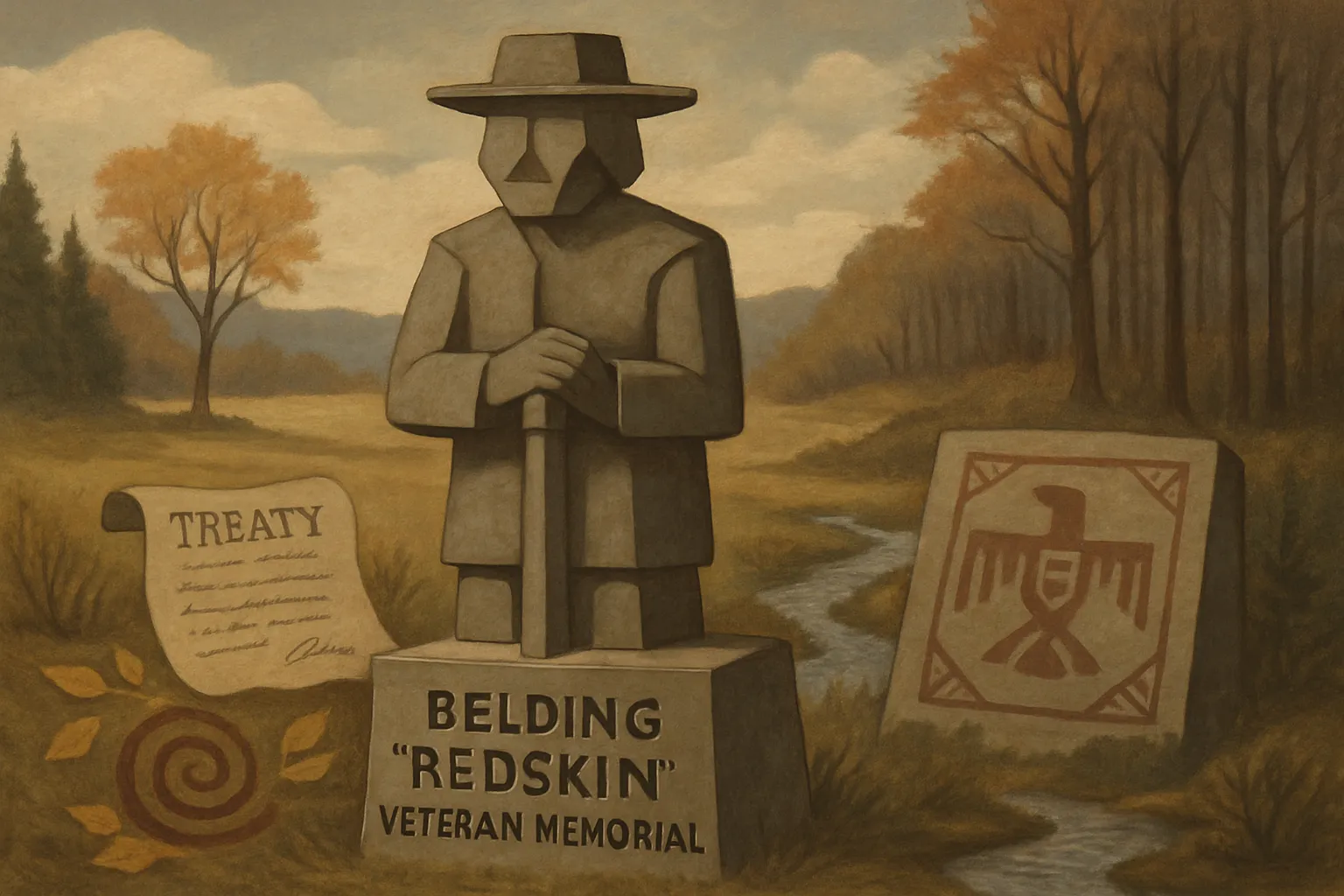
The Belding "Redskin" Memorial: A Critique of Settler Ideology
The Belding "Redskin" Memorial in the Denny Craycraft Veterans Park is not a neutral tribute but a structural manifestation of settler colonial ideology. This monument, dedicated to patriotic memory, functions as an ideological fantasy screen, stabilizing the local Caucasian community’s fractured historical narrative by actively repressing the traumatic kernel of colonial displacement (Tuck & Yang, 2012). Applying the psychoanalytic framework of Slavoj Žižek, particularly the concepts of the Rigid Designator and the Objet a (1989), this analysis deconstructs the memorial as a sophisticated ideological apparatus.
Ideology, in this context, is the structure that organizes reality, ensuring the subject perceives the world as coherent and stable by systematically hiding the Real—the non-symbolizable void or trauma—at its core (Žižek, 1989).
The "Redskin" memorial is thus the symbolic scaffolding built over the trauma of stolen land.
I. The Mascot as Structural Anti-Semitism: The Thief of Jouissance
The analysis begins by establishing the structural homology between the "Redskin" mascot and the figure of the "Jew" in ideological anti-Semitism, as outlined by Žižek (1989). The core of this ideological project is the symbolic construction of the mascot as the figure onto whom the Caucasian community projects its fundamental lack, enabling the theft of enjoyment (jouissance).
The Rigid Designator and the Stolen Objet a
Žižek (1989) posits that a racist fantasy requires an external figure, like the "Jew" in anti-Semitism, who is perceived as having access to a stolen surplus of enjoyment (jouissance) that the oppressor community lacks. This figure is constructed as the thief of enjoyment, the holder of the secret to the oppressor's own inability to achieve symbolic wholeness. This stolen secret is the Objet a, the elusive object cause of desire (Lacan, 1977).
In Belding, the "Redskin" mascot functions as this Rigid Designator. It is aggressively decoupled from its authentic Indigenous history and its derogatory meaning, becoming a purely self-referential image for the majority white community. The signifier is not tied to any actual veteran, but to the spectral Objet a of the community’s pure, uncomplicated past enjoyment—the "IT-ness" of being a Redskin.
The physical memorial is the inert remainder, the "little piece of the Real" that bears witness to an impossible promise (Žižek, 1991). The actual enjoyment (jouissance) is not in the statue itself, but in the spectral void it frames: the sense of shared, guilt-free community identity. By appropriating the "Redskin" signifier, the settlers symbolically seize this forbidden jouissance that they project onto the Native figure, thereby purifying and stabilizing their own white identity (Butler, 2004). The intense, ritualistic honoring of the mascot is a necessary symbolic overkill, distracting the community from the brutal Real of the traumatic historical absence (Žižek, 1989).
II. Rewriting History: The Point de Capiton of Settler Innocence
If the mascot functions as the Objet a that stabilizes desire, the community’s historical distortion must function as the quilting point (point de capiton) that stabilizes the Symbolic Order—the field of law and language (Lacan, 1977). This necessary ideological maneuver is accomplished through the manipulation of the memorial’s timeline. The attempt to backdate the Redskin Memorial to the founding of Belding in 1893 (rather than the mascot's actual 1940s inception) constitutes this vital structural intervention.
The Function of the Point de Capiton
The quilting point is the master signifier that stops the chaotic, unstructured slide of floating signifiers (historical facts, colonial violence, and shame) and anchors them into a fixed, stable ideology. The historical retrofit achieves two acts of repression crucial for settler colonial logic:
Surgical Erasure of the Real Traumatic Date: The problematic 1940s origin, which carries the weight of conscious racist choice, is surgically removed from the symbolic chain (Tuck & Yang, 2012). This preserves the settler community's performative innocence by eliminating the moment of choice.
The Fantasy of the "Always Already Redskin": This historical distortion produces the ultimate ideological fantasy: that the Caucasian settlers were "always already Redskin." This is the ultimate goal of settler colonial logic—the elimination of the Native to claim indigenous rootedness without indigenous guilt (Wolfe, 2006). By tying the signifier to the origin of the community, the memorial suggests that the land and the identity were not taken but were inherited from the community's inception. The Redskin thus becomes the foundational signifier of the white community itself, securing their identity by fictionalizing the history of their presence. The memorial performs memory without performing justice (Žižek, 1991).
III. The Symptom: The Active Absence of the Indigenous Veteran
The failures of the Symbolic Order established in Section II—specifically the inability to fully repress the trauma of colonial land theft—must manifest somewhere. In the Veteran Belding park, this repressed truth returns as the symptom (Žižek, 1989): the active absence of a Native American veteran memorial.
The Sacrifice of the Real and the Symptom
The symptom, in Žižekian theory, is the point where the Symbolic system fails, and the repressed truth of the underlying trauma—the Real—erupts (Žižek, 1989). The active absence of the Native veteran memorial is the symptom of the colonial lie.
The Redskin memorial honors a dead icon—a signifier devoid of signified substance—to preserve the community's enjoyment (jouissance). The intense symbolic focus on this Dead Icon acts as a symbolic sacrifice that allows the community to ignore the Real traumatic subject (the Indigenous veteran). The dedication to the mascot is fundamentally a fight for the preservation of a threatened white identity, not for the honor of a marginalized group (King, 2022).
The Failure of the Symbolic: The Unthinkable
The memorial is only a tribute to a dead icon because its meaning is self-referential to the community's fantasy. Since there is no actual signifier for the Native American veteran—no quilting point to stabilize their presence within the park's Symbolic economy—they remain a floating signifier, effectively relegated to the category of the unthinkable. The settler community's ideological structure simply cannot admit the material existence of the Indigenous subject within the celebratory space without collapsing the entire fantasy of the "always already Redskin" identity. Thus, the Redskin memorial, far from being a testament to history, is a monument to a fundamental ideological lie, functioning as the spectral Objet a that stabilizes a local identity structure by ritually and actively erasing the trauma of its own foundation.
References
Bhabha, H. K. (1994). The location of culture. Routledge.
Butler, J. (2004). Precarious life: The powers of mourning and violence. Verso.
Derrida, J. (2010). Speech and phenomena: And other essays on Husserl’s theory of signs. Northwestern University Press.
King, C. R. (2022). The Native American mascot controversy: A handbook. Scarecrow Press.
Lacan, J. (1977). Écrits: A selection. (A. Sheridan, Trans.). W. W. Norton & Company.
Tuck, E., & Yang, K. W. (2012). Decolonization is not a metaphor. Decolonization: Indigeneity, Education & Society, 1(1), 1–40.
Wolfe, P. (2006). Settler colonialism and the elimination of the native. Journal of Genocide Research, 8(4), 387–409.
Žižek, S. (1989). The sublime object of ideology. Verso.
Žižek, S. (1991). Looking awry: An introduction to Jacques Lacan through popular culture. MIT Press.