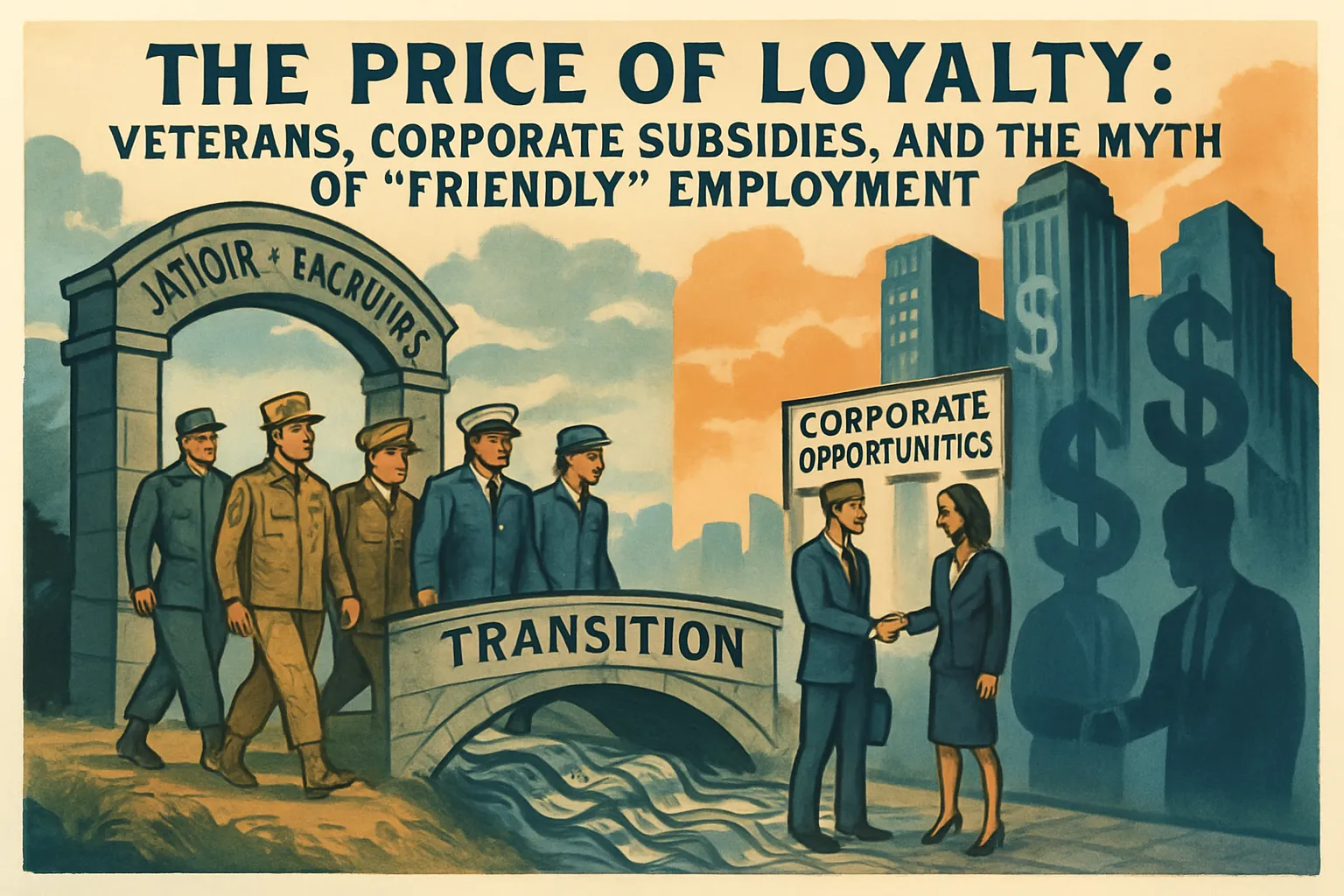
The Michigan Veterans Affairs Agency (MVAA) program, exemplified by the profile of Sandra Philpott-Burke, functions as a classic institutional response to state violence. It is an exercise in public relations designed to mask the enormous material and psychological cost of war by substituting symbolic awards for systemic support. The MVAA's tiered "Veteran-Friendly Employer" system transforms genuine, decentralized mutual aid into a formalized, marketable commodity that benefits the state and corporate actors, while managing the dissent of the exploited population—the veterans themselves.
I. The Corporate Subsidy and the Illusion of Benevolence
The MVAA’s Veteran-Friendly Employer designation—Bronze, Silver, Gold—is not fundamentally a support system for veterans; it is a state subsidy for corporate and government employment. This program allows institutions like the Department of Environment, Great Lakes, and Energy (EGLE) to externalize the costs of employee recruitment, training, and integration.
While such certification programs may ensure compliance with basic labor standards—a necessary but minimal concession—their institutional benefits are far more significant:
Recruitment of Compliant Labor: The state apparatus (like EGLE) gains access to a pool of highly trained, disciplined, and often desperate labor, directly subsidized by prior military training. The certification essentially fast-tracks veterans back into the service of the state bureaucracy.
Financial Incentives for Capital: Beyond cheap labor, the "Veteran-Friendly" status directly lowers the overhead costs for certified employers. This includes access to state-managed wage reimbursement programs, targeted hiring grants, and, most critically, tax credit eligibility for organizations that meet employment quotas. The MVAA program is, therefore, a mechanism for the state to funnel taxpayer money directly into corporate balance sheets, using veteran employment as the legal justification.
Image Management: Corporations and government agencies receive cheap Public Relations (PR) and an official state endorsement, enabling them to market themselves as "patriotic" while actively participating in the economic structure that demands imperial conflict. The MVAA's audit data becomes a public commodity used for branding.
Offloading of State Debt: By encouraging employers to provide veteran support (like the EGLE Vets ERG), the MVAA offloads the state's moral and financial obligation for post-service psychological and medical care onto the corporate sector or, worse, unpaid volunteer labor. The bureaucratic checklist replaces the need for unconditional universal care.
The program generates the appearance of substantive benevolence, thus pacifying potential critique by redirecting focus toward individual corporate "effort" rather than the failure of the state to provide unconditional care.
II. Recognition as a Ritual of Debt Cancellation and Narrative Control
The state's practice of issuing ceremonial documents, such as the Vietnam Veteran certificate, is a cynical mechanism for the ritualized cancellation of debt and the control of public memory.
The state demands total sacrifice in service to its economic and geopolitical objectives. The "repayment" offered decades later is not in material security (guaranteed healthcare, housing, or non-exploitative employment); it is in decorative symbols—a meaningless gesture that attempts to close the ledger on the state's debt without actual transfer of value.
The primary function of these ceremonies is not to honor, but to enforce a narrative of "service and sacrifice." By focusing on themes of gratitude, the state strategically excludes critical veterans' voices—those who protest the wars, suffer from neglect, or organize politically—from the acceptable public narrative.
The Psychological Mandate: "Reintegration" is the program's ultimate ideological goal. The MVAA system is designed to perform a psychological operation: re-militarizing the veteran's identity from a warrior for the state's geopolitical goals into a disciplined, productive, and compliant citizen for the state's economic goals. The ideal outcome is a veteran who accepts the rules of capital, is grateful for their employment subsidy, and remains politically inert—a "docile citizen" who directs any anger inward rather than outward toward the structures that exploited them.
MVAA as Social Gatekeeper: The MVAA effectively acts as a gatekeeper of veteran legitimacy, implicitly defining the "acceptable" veteran as one who is employed by a certified corporation and who participates in state-approved channels of support. This marginalizes the veteran who is chronically disabled, homeless, politically radical, or who refuses the reintegration mandate. The system uses its power of recognition to enforce a class structure within the veteran community, isolating dissenters and prioritizing the compliance of its beneficiaries.
III. The Co-option of Authentic Mutual Aid
The tireless work of individuals like Sandra Philpott-Burke—her hygiene drives, resource center management, and direct outreach—represents the authentic power of decentralized, community-based mutual aid. This horizontal solidarity is inherently anti-establishment and capable of exposing the state's failures through direct action.
However, the state and corporate apparatus inevitably attempts to absorb this genuine effort:
The Muzzle: The MVAA’s nomination and EGLE’s awards act as an institutional muzzle. By officially recognizing Sandra, the state legitimizes her methods while stripping them of their revolutionary context. Her success is reframed as evidence of the bureaucracy's effectiveness, not its failure. The institution takes ownership of the good deed.
The Verticalization of Solidarity: Sandra's work is based on horizontal solidarity—peers helping peers. The state, through the award structure, attempts to transform this into vertical charity—a system managed and validated by elites and administrators. The focus shifts from the needs being met to the status of the organization meeting them, centralizing control over decentralized compassion.
The Charity Complex as a Buffer: The MVAA system works in concert with the enormous, capital-intensive ecosystem of veteran non-profits and charities. This charity structure is the secondary line of state defense, diverting public consciousness and veteran energy away from demanding structural change (e.g., universal, unconditional trauma care) toward funding thousands of discrete, localized, and ultimately non-threatening solutions (e.g., funding a service dog, building one adaptive ramp). The MVAA program validates and streamlines this capitalist charity model, ensuring that the human consequences of state violence are managed via philanthropy, not political accountability.
The true strength of veteran support lies in autonomous action, unmediated by government oversight or corporate validation. The state’s intervention corrupts this autonomy, ensuring that the resources generated by community spirit are redirected to polishing the institutional brand (EGLE’s Gold-level status).
IV. The Strategic Linkage: Sustaining the US Imperial Project
The location of this veteran recognition program within the Department of Environment, Great Lakes, and Energy (EGLE) is structurally illuminating.
The modern state bureaucracy requires stability and sustainability across all sectors to ensure the continued function of the Military-Industrial Complex (MIC). The MVAA is not an optional benevolent program; it is a mandatory administrative cost of the US Imperial Project. The MVAA's core function is to manage the domestic human consequences of foreign wars, preventing the destabilizing social crises (PTSD, suicide, homelessness) that could erode public support for future conflicts.
EGLE’s seemingly benevolent environmental work (EV chargers, Justice40 Accelerator) is necessary to sustain the productive base of capital, mitigating ecological crises that could destabilize the economy. Similarly, the MVAA program is necessary to sustain the human capital base, mitigating social crises that could destabilize the social order.
The state, which creates veterans through its geopolitical imperatives, then uses its internal agencies—be they environmental or administrative—to manage the human fallout. The critique must be comprehensive: the reintegration of veterans into a civilian workforce at an agency like EGLE is not a humanitarian effort, but a strategic administrative function to maintain the continuous operation of the capitalist-militarist state.
Conclusion: Organizing for Autonomous Solidarity
The MVAA's recognition system is fundamentally a distraction from the structural accountability owed to veterans. The necessary response is not to appeal to the state for "better" programs, but to engage in the informed rejection of institutional mechanisms that exploit and pacify this population.
We must reject the manufactured consensus of "corporate friendliness" and demand the abolition of the systems—the wars, the economic precarity, the institutional neglect—that necessitate the creation of such a debt in the first place.
The real honor due to veterans is found in autonomous solidarity from below: organizing structures that empower veterans directly. This includes the establishment of veteran-run mutual aid networks, community-managed health clinics specializing in trauma, and democratic worker co-operatives that ensure non-exploitative employment. This is the practical realization of an anti-authoritarian model, dedicated to dismantling the power structures that treat human life as disposable capital.