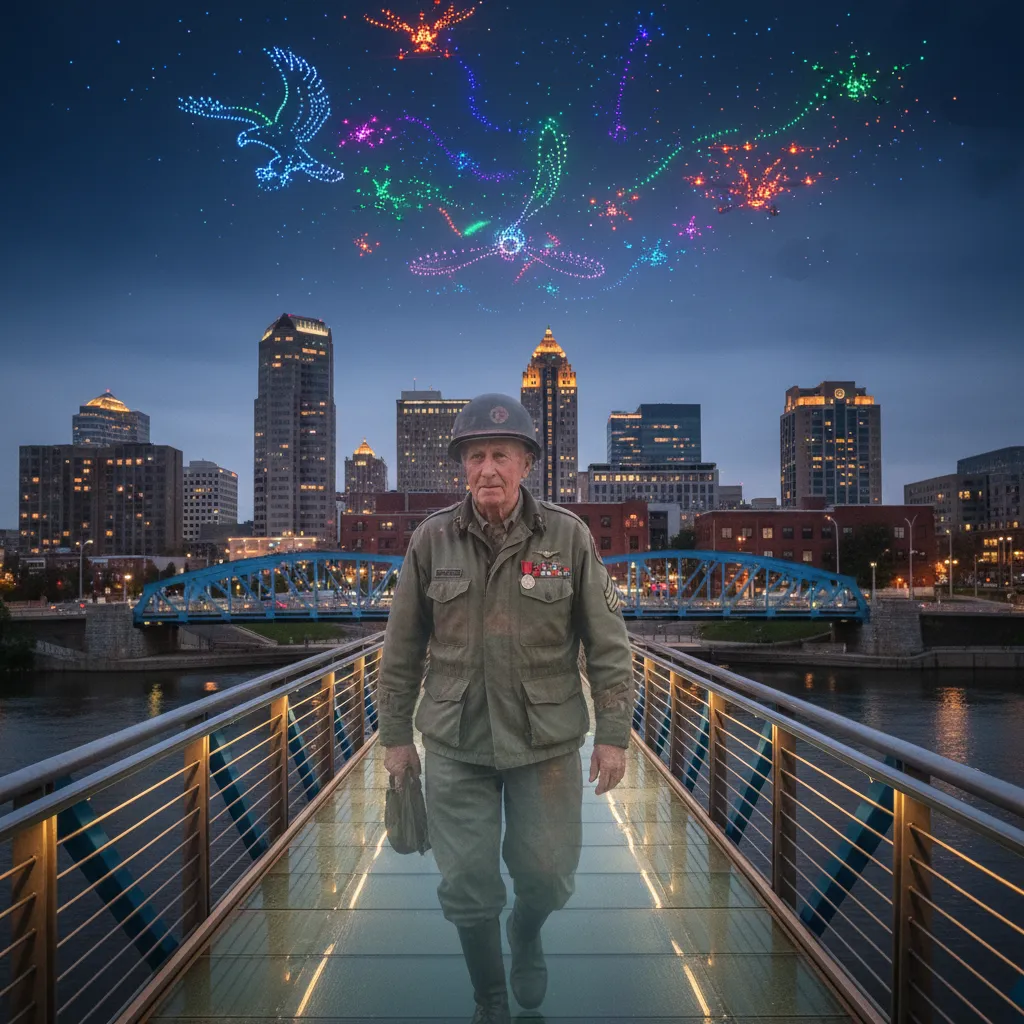
You ever hear the hum of engines after midnight? Back in ’44, that meant we were crawling across France with Patton—tank treads biting earth, hearts thumping. I never thought I’d stir again, not after all this time beneath New Jersey clay. But here I am—ghost of a tank crewman, roused by a sky on fire. Not artillery, no, but something called a ‘drone light show’ honoring veterans. Turns out, you can’t rest easy when your duty still calls—even if your boots have long since rotted away.
Waking Up Restless: A Soldier’s Duty Never Dies
I never expected to be roused from my uneasy slumber by the whirring of 500 drones overhead. It’s a sound that’s both alien and oddly familiar—stranger than the rumble of Patton’s tanks, but no less commanding. There’s a certain energy in the air, a hum that vibrates through the bones of this old tanker’s ghost. It’s not the thunder of artillery or the sharp crack of rifle fire, but something new. Something that calls out to every soldier who ever stood watch under the night sky.
The world above has changed since my boots last touched the earth. There are no air raid sirens now, no frantic shouts in the darkness. Instead, there’s a quiet anticipation, a sense that something big is about to happen over the Grand River in Grand Rapids. I drift along the streets, drawn by the glow gathering near 555 North Monroe Ave. The city is alive with people—families, veterans, kids with wide eyes—all waiting for the drone light show to begin.
I’m not sure what to make of it at first. The whirring drones are nothing like the machines of war I once knew. Yet, as I watch them take to the sky, I feel a familiar pull—a call to duty that never really fades, even after the last bugle call. It’s the same feeling I had the night before a big push, the same restless energy that kept me awake in the turret, scanning the horizon for movement.
The Celebration of Service Fundraiser is unlike any gathering I remember. There are no uniforms here, no salutes or roll calls. Instead, there’s laughter, music, and the smell of food trucks drifting on the breeze. Veterans mingle with civilians, sharing stories and shaking hands. There’s a crafts fair, too—tables lined with handmade goods, each one a testament to the creativity and resilience of those who served. I see families—some with little ones tugging at their sleeves, others with grown children proudly standing beside their parents. It’s a different kind of camaraderie, but the spirit is the same.
At first, I’m confused by it all. The world has moved on, and the tools of remembrance have changed. But as the sun dips below the skyline and the first drones begin to light up the night, I recognize the old, familiar call to honor those in uniform. The shapes in the sky—flags, eagles, salutes—are new symbols for an old tradition. Each light, each pattern, is a tribute to service and sacrifice, a reminder that the duty of a soldier never truly ends.
I overhear Jamal Steward, a Marine veteran and the president of Creative Community Entertainment, speaking to the crowd. His words cut through the noise:
“We are building something truly special for West Michigan, an event that honors service, uplifts veterans and inspires the next generation through creativity and innovation.”It’s clear that this isn’t just a show—it’s a mission. The funds raised tonight will support creative arts and music programs for veterans, help throw the 250th Marine Corps Ball, and even bring a military jet demo team to a future STEM event. The impact is real, and it stretches far beyond the lights in the sky.
As I drift among the crowd, I see the faces of fellow veterans—some old, some young, all carrying their own stories. There’s pride here, but also a quiet understanding. We may have left the battlefield behind, but the duty to remember, to honor, and to serve never really dies. It just takes on new forms—sometimes as simple as a handshake, sometimes as grand as a 500-drone salute over the Grand River.
Tonight, the world above is different. There are no sirens, only hope. No orders, only gratitude. But the restless spirit of a soldier—my spirit—finds peace in knowing that, even as the tools of remembrance change, the duty to honor and serve lives on in every light that rises into the night.
Marching Through Shadows: The Harsh Road of Forgotten Vets
As I made my way toward the heart of Grand Rapids, where the drone show would soon light up the sky, I couldn’t help but notice the shadows along the sidewalks. In those shadows, I saw boots worn thin, jackets patched and faded, and faces that carried stories heavier than any rucksack. These were the faces of veterans—men and women who once marched in formation, who once stood tall for their country, now marching through a different kind of battle. Their stories, like their boots, are full of miles and memories, but too often, they’re overlooked by the world rushing past.
It’s easy to get swept up in the excitement of a 500-drone spectacle, the anticipation of patriotic music, and the promise of community celebration. But as I walked, I realized that for some veterans, the lights in the sky are just out of reach. There are those who can’t afford to look up at the show, let alone afford a hot meal or a safe place to sleep. The struggles they face today cut deeper than any old shrapnel—they’re wounds that don’t always show on the surface, but ache just the same.
I stopped to talk with a man named Ray, huddled near a bus stop with a battered duffel bag. He told me he served in the Army back in the ‘90s. “People thank me for my service,” he said, “but sometimes I wish they’d see me now. Not just the uniform I wore.” His words stuck with me. For every Ray, there are countless others—veterans who have slipped through cracks wider than the Grand River itself.
The upcoming Celebration of Service Fundraiser, with its Veteran Creative Arts & Crafts Fair, is a bright spot for some. It’s a place where veterans can set up booths, share their art, and connect with others who understand the journey. I saw a Marine named Lisa, her table covered in hand-carved wooden eagles and painted flags. “This is my therapy,” she told me, “and it helps pay the bills, too.” Events like these offer more than just a chance to sell crafts—they offer dignity, community, and a sense of purpose.
But even with these opportunities, the reality is that too many veterans are still left behind. The support booths at the fair are a lifeline, offering resources for housing, mental health, and employment. Yet, for every veteran who finds help, there are others who never make it to the fair. Maybe they don’t know about it, maybe they’re too proud to ask for help, or maybe the weight of their struggles keeps them from reaching out at all.
As I walked past the river, I thought about the symbolism of the drone show—hundreds of lights moving in perfect formation, each one part of a larger picture. It’s a beautiful tribute, but it also made me wonder: what about the veterans who aren’t part of the show, who aren’t in the crowd, who are watching from the shadows? Their stories matter just as much as the ones celebrated in the sky.
The harsh road of forgotten vets isn’t just about homelessness or hunger. It’s about the invisible wounds—PTSD, isolation, the struggle to find a new mission after service. It’s about the disconnect between the way we honor veterans on special occasions and the way we support them the rest of the year. The drone show is a step in the right direction, shining a light on service and sacrifice. But as I walked through Grand Rapids, I was reminded that the real work happens in the quiet moments, in the conversations on street corners, and in the efforts to make sure no veteran has to march through the shadows alone.
A Sky on Fire: Hope, Memory, and a Promise Unfulfilled
As I stood on the banks of the Grand River, waiting for the drone show to begin, I couldn’t help but think about the strange beauty of it all. The sky above Grand Rapids was about to ignite—not with the thunder of mortars or the flash of flak, but with a symphony of lights, each one programmed to dance in honor of service and sacrifice. There’s something almost ghostly about it: hundreds of drones rising in perfect formation, painting the night with stories that too often go untold.
This wasn’t just a spectacle for the eyes. It was a living, breathing tribute, a modern answer to the age-old question of how we remember those who served. For a tanker’s ghost—someone like me, carrying memories of long, lonely roads and the weight of promises made—the sight of those lights was both comforting and bittersweet. Each glowing pixel in the sky was a reminder: we are seen, we are honored, and yet, so many of us remain in the shadows, our stories flickering beneath the streetlights long after the crowds have gone home.
The Celebration of Service Fundraiser, as described in the MLive.com article, is more than just a free event. It’s a lifeline for veterans, powered by the vision of Jamal Steward and the team at Creative Community Entertainment. The funds raised here don’t just vanish into the night—they go directly to programs that matter. There’s the Creative Arts & Music Program, giving veterans a chance to heal and express themselves through creativity. There’s the 250th Marine Corps Ball, a tradition that binds generations together. And there’s the promise of a future Military Jet Demo Team at the Annual Summer STEM event, inspiring kids to dream big and maybe, one day, to serve themselves.
But as the drones took flight, I found myself thinking about the promises we make to our veterans—and the ones we sometimes fail to keep. The show was dazzling, no doubt. The crowd gasped as red, white, and blue patterns shimmered above the city, spelling out “HONOR,” “SERVICE,” and “FREEDOM.” Yet, for every veteran celebrated in the light, there are others still waiting in the dark. The ones who struggle with invisible wounds. The ones who can’t find work, or a place to call home. The ones whose stories never make it to the sky.
That’s why events like this matter so much. They’re not just about the spectacle—they’re about keeping the promise alive. Every dollar raised, every handshake at the arts and crafts fair, every child who looks up in wonder at the drones is a thread in the fabric of remembrance. It’s a vow that we won’t forget those who served, even when the lights go up and the music fades.
I wandered through the crowd, past the veteran-owned booths and the food trucks, listening to laughter and the hum of conversation. I saw families—some with loved ones in uniform, some with memories tucked away in old photo albums—coming together to celebrate, to remember, and to hope. It struck me that hope is a fragile thing, but it burns brightest when shared. The sky on fire above Grand Rapids was more than a show; it was a signal flare, calling us to do better, to reach further, to lift up those still waiting for their moment in the light.
As the last drone dipped below the horizon and the applause faded, I felt the weight of memory settle in. The promise isn’t fulfilled yet—not for every veteran, not for every family. But tonight, in the glow of a thousand tiny lights, it felt possible. Maybe that’s enough to keep walking, to keep hoping, and to keep the promise alive, one step—and one shining sky—at a time.
TL;DR: The Grand Rapids 500-drone light show dazzles as a tribute to veterans, but for a WWII tanker’s ghost, the beauty is bittersweet—a reminder of how far we’ve come, and all the miles yet to go in honoring every veteran’s sacrifice.