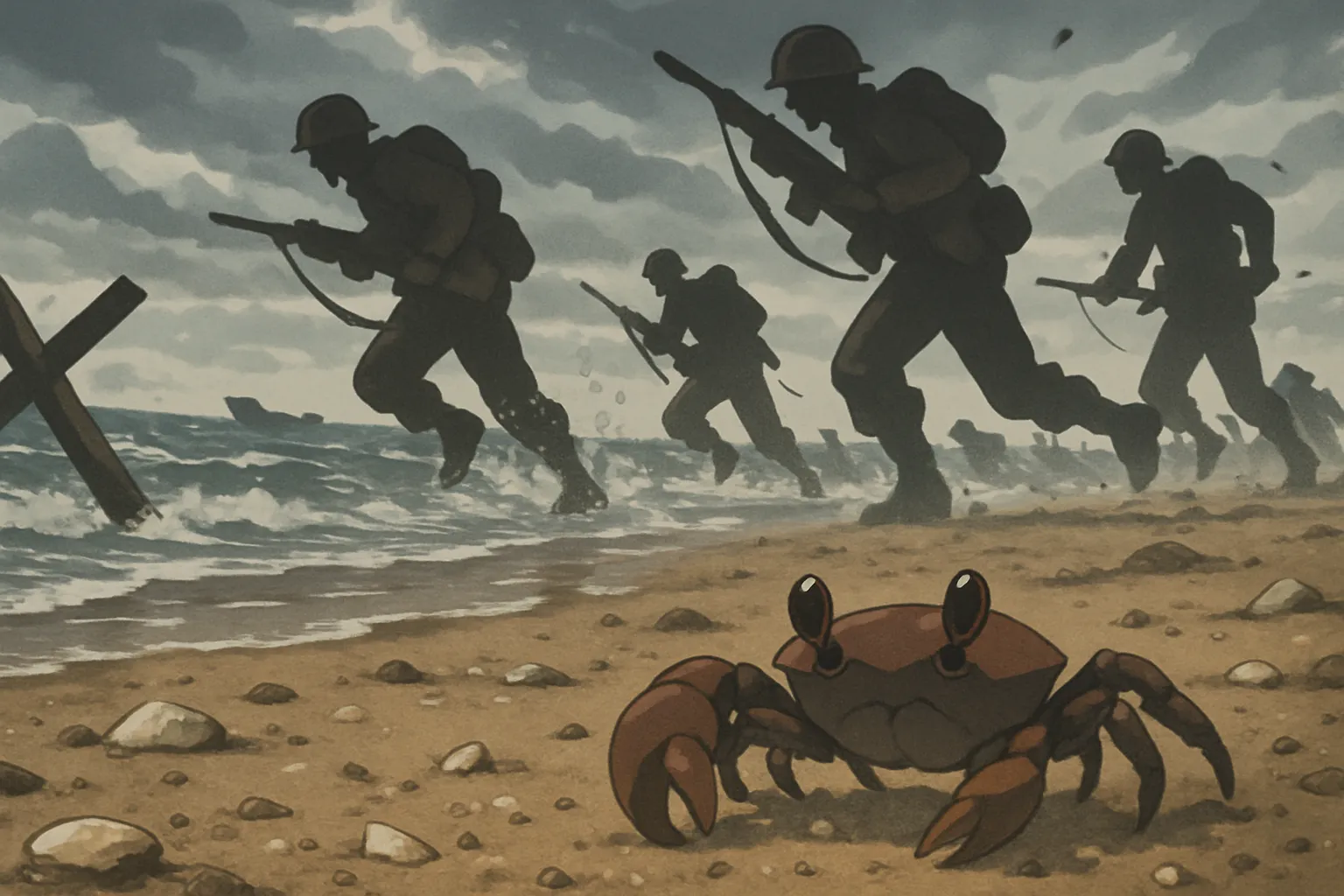
Imagine a lowly crab scruttling across Omaha Beach, witnessing history unfold from the sandy shore where tides once swallowed bravery whole. Through my many years clacking along these shores, I've seen more than just waves. I've seen human courage, the stealthy approach of warriors from distant lands, and the echoes of battle that still whisper beneath the wind’s howl. This is the story of Charles Shay, a Penobscot medic who danced on the edge of life and death on D-Day. I tell it not just as a crustacean spectator but as a keeper of the sands’ memories.
From Tide Pools to War Tales: A Crab’s Perspective on Charles Shay’s Early Life and D-Day Landing
If you could see the world through my eyes—a crab scuttling across the shifting sands of Omaha Beach—you’d know that every shell, every ripple, and every shadow tells a story. On June 6, 1944, the beach was alive with more than just the usual tide pool creatures. That day, the sand trembled with the footsteps of brave men, including a young Penobscot medic named Charles Shay.
Born in 1924 in Bristol, Connecticut, Charles Shay’s early life was a journey of resilience. One of nine children, he found himself swept from crowded city classrooms to the wild beauty of the Penobscot Nation reservation in Maine. There, the world was different—school was not just a building, but a destination reached by ferry, canoe, or even a careful walk across frozen winter ice. Shay’s determination to get an education was as fierce as a crab’s will to survive the pounding surf and hungry gulls.
As I watched from my tide pool, I saw how those early lessons shaped him. Every challenge—whether it was being the only Indian boy in a class of forty or braving the elements—honed his spirit. That same grit would carry him far from the quiet rivers of Maine to the roaring chaos of Omaha Beach.
On D-Day, the sand was no longer just my home. It became the stage for one of history’s greatest battles. Shay landed in the first assault wave with the 1st Infantry Division, the “Big Red One.” The Germans were waiting, their machine guns spitting fire and steel. The air was thick with smoke, shouts, and the cries of the wounded. Survival meant moving fast and staying low—skills I know well as a crab dodging danger.
Shay’s instincts were razor-sharp. As bullets tore through the surf, he focused on saving lives. Again and again, he dashed back into the rising tide, pulling wounded comrades to safety. Each trip was a gamble, but he pressed on, driven by duty and something deeper—a connection to his people and the land, as ancient as the tides themselves.
- Born in 1924: Charles Shay’s journey began in Bristol, Connecticut, before moving to the Penobscot Nation reservation in Maine.
- Early hardship: He braved long, cold journeys to school, often the only Native American boy in his class.
- D-Day landing: On June 6, 1944, Shay landed in the first assault wave at Omaha Beach, facing entrenched German resistance.
- Native American warriors: Shay was one of approximately 175 Native Americans who stormed Omaha Beach that day, their resilience echoing the survival instincts of creatures like me, clinging to life between sand and sea.
The horrors of that day left deep marks, but also revealed the strength within. Shay’s story, seen from my crab’s-eye view, is one of courage—of a young man shaped by hardship, who faced the storm and never stopped fighting for those beside him.
Bravery Amid the Tide: Shay’s Medic Actions and Military Service in WWII and Beyond
Looking back, I am still amazed by the path that took me from the Penobscot Nation in Maine to the chaos of Omaha Beach on D-Day. On June 6, 1944, I was just 19 years old, a medic with the 1st Infantry Division—the “Big Red One”—and one of about 500 Native Americans in the invasion force. The beach was a nightmare of noise and terror: machine gun fire, exploding shells, and the cries of wounded men. My only thought was to help my comrades survive.
As the tide rose and bullets tore through the surf, I saw soldiers struggling in the water, wounded and unable to move. Again and again, I ran back into the freezing waves, risking my life to pull them to safety. I turned men over so they wouldn’t drown, dragged them out of the surf, and tried to stop their bleeding right there on the sand. The screams, the suffering, and the memory of giving morphine—and a final goodbye—to a dying fellow medic have never left me.
- Repeated Acts of Bravery: Despite the horror, I kept going back into the surf, driven by duty and a sense that something—maybe a guiding spirit—was watching over me.
- Recognition for Valor: For my actions on Omaha Beach, I was awarded the Silver Star, one of the Army’s highest honors, and later the French Légion d’honneur.
But D-Day was only the beginning. I spent nearly a year on the front lines, facing the bitter cold and relentless fighting of the Battle of the Bulge. When I was captured, I survived almost a month in a German prison camp before being liberated. My family back home had been told I was missing in action. When I finally returned to the Penobscot reservation, my mother could hardly believe her eyes.
After the war, my service continued. In Vienna, Austria, I worked as a military policeman, where I met my beloved Lilli. Our life together lasted until her passing in 2003. My military career spanned more than two decades. I became a master sergeant, served in Korea—earning three Bronze Stars with “V” devices for valor—and joined the Air Force in 1952. I was stationed at Tinker Air Force Base in Oklahoma, then assigned to live nuclear test operations in the Marshall Islands. I finally retired in 1964.
Years later, I returned to Omaha Beach, standing on the same sand where I had once fought to save lives. The memories came flooding back—the chaos, the fear, and the courage of so many Native American warriors who landed beside me. In 2017, a memorial bust was placed above the beach, now part of the Charles Shay Indian Memorial at Saint-Laurent-sur-Mer. It stands as a tribute to all Native Americans who served on D-Day, whose bravery often went unrecognized.
I spent my later years in Normandy, welcoming American troops and visitors, sharing the stories of Native warriors, and honoring the sacrifices that shaped our world.
From the Sands to the Memorial: Honoring Charles Shay and Native American Warriors at Normandy
Returning to Omaha Beach after so many years was like walking into a living memory. The sand felt familiar beneath my feet, yet every wave seemed to whisper the stories of those who never left. I was no longer the young medic who landed in the first wave on June 6, 1944, but the echoes of that day—of chaos, courage, and loss—remained etched in my heart. Just as the beach is reshaped by each tide but endures, so too did I carry the marks of war, changed but unbroken.
When I first came back, it was decades after that fateful morning. I stood quietly, looking out over the water, remembering the faces of the men I tried to save. I thought of the other Native American warriors—about 500 of us drafted, with up to 175 landing on Omaha Beach that day. Our stories were often left out of history books, but we were there, side by side with our brothers-in-arms, facing the same danger and showing the same determination.
In 2017, something remarkable happened. A memorial bust was installed in my honor above Omaha Beach, part of the Charles Shay Indian Memorial at Saint-Laurent-sur-Mer. It was the first monument in France dedicated to Native American soldiers who fought on D-Day. I felt humbled and proud—not just for myself, but for all the Native warriors whose bravery had gone unrecognized for so long. The memorial stands on a quiet bluff, looking out over the sand and sea, a place for reflection and remembrance.
The memorial is more than just a statue. It is a symbol—a promise that our sacrifices will not be forgotten. Each year, on the anniversary of D-Day, people gather there to pay their respects. Veterans, families, and visitors from around the world come to learn about the Native Americans who landed on those shores, many of whom never made it home. I spent my final years living nearby, in Thue et Mue, Normandy, welcoming guests and sharing our stories. I wanted everyone to know that Native Americans served with honor, courage, and a deep sense of duty.
- Returning to Omaha Beach: The memories were heavy, but the spirit of resilience remained, much like the ever-changing yet enduring shoreline.
- Charles Shay Indian Memorial: Installed in 2017, this was the first monument in France to honor Native American D-Day soldiers, standing as a tribute to their bravery.
- Sharing Our Stories: In my final years, I dedicated myself to welcoming visitors and ensuring the legacy of Native warriors was remembered on the very sands where history was made.
As I stood on those sands, I often thought of the guiding spirit that watched over me and so many others. The Charles Shay Indian Memorial is not just my story—it is the story of all Native American soldiers who fought, endured, and shaped the world we know today.
Wild Card: If This Beach Could Talk — Imagining the Conversations Between the Sand, the Sea, and the Soldiers’ Spirits
If Omaha Beach could speak, its voice would be a chorus of memory—the sand, the sea, and the spirits of those who landed here on D-Day. I often imagine what the beach would say if it could tell its story. From my crab’s-eye view, I see more than just grains of sand and rolling tides. I see a living memorial, shaped by every footstep, every cry, and every act of courage that unfolded on June 6, 1944.
The sand remembers. It remembers the boots that pressed down in fear and hope, the hands that dug for cover, and the tears that mixed with saltwater. It remembers the Native American warriors—like myself and my brothers—who brought the strength of our ancestors to this foreign shore. The sand is a silent witness, holding the echoes of our determination and sacrifice. Even now, when I walk along Omaha Beach, I feel the weight of those memories under my feet, as if the ground itself is whispering, “I remember you.”
The sea, too, has its stories. It carried us in, cold and relentless, pushing us forward when every instinct screamed to turn back. The waves crashed around us, hiding our fears and washing away the blood and pain. But the sea also carried our courage. If you listen to the surf, you might hear the voices of the Penobscot, the Navajo, the Sioux, and so many others who fought not just for survival, but for each other. The sea remembers the moments when I ran back into the water, again and again, to pull my wounded brothers to safety. It remembers the prayers whispered into the wind and the final goodbyes offered to those we could not save.
If I, a humble crab, could speak for this place, I would tell you that the courage of Native soldiers still resonates here. Every crashing wave, every gust of wind, carries the spirit of those who stood firm against impossible odds. The beach is more than a place—it is a living memorial, a bridge between past and future. The tides carry our stories forward, reminding each new visitor to honor the bravery and resilience that shaped this world.
When I returned to Omaha Beach after so many years, I felt the presence of those who never left. The sand and sea welcomed me home, and the spirits of my comrades seemed to rise with the morning mist. Now, with the Charles Shay Indian Memorial watching over the shore, our stories are no longer hidden. They stand in the sunlight, remembered by all who walk these sands.
As I look back on my journey—from the Penobscot Nation to Normandy and beyond—I am humbled by the endurance of this place and the people who shaped it. May the conversations between the sand, the sea, and the soldiers’ spirits continue, reminding us all to honor the sacrifices made here. Omaha Beach remembers, and so must we.
TL;DR: Charles Shay’s journey from the Penobscot Nation to Omaha Beach was marked by bravery and sacrifice amid WWII’s fiercest combat. His legacy, honored by memorials and stories, reminds us of the often-overlooked Native American contribution to the Normandy invasion, all seen through the curious eyes of a beach crab who watched history unfold.