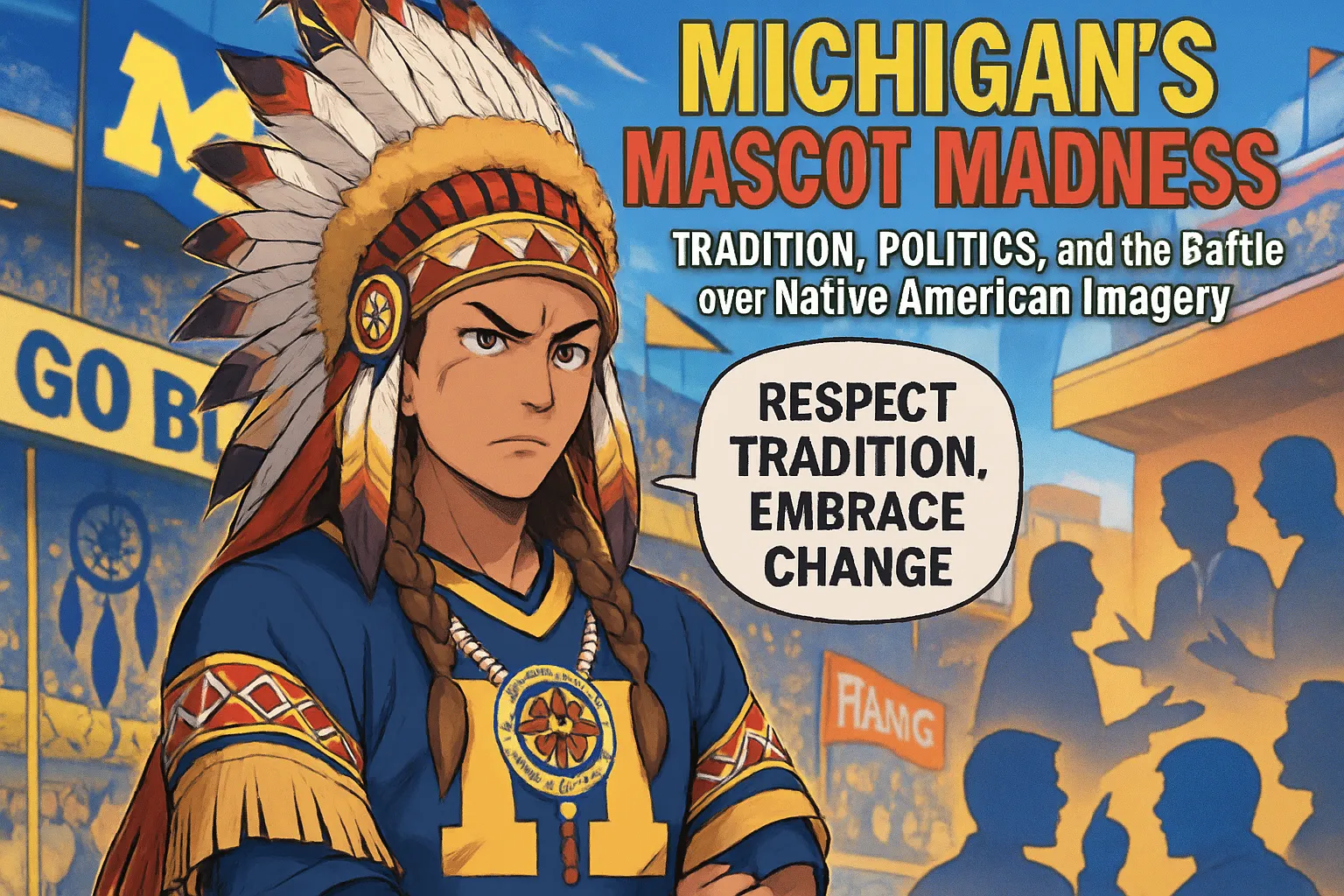
As a lifelong sports fan and an artist who loves tradition, I found the Michigan mascot debates around the Redskins nickname deeply personal—and surprisingly complex. While watching the Detroit Lions gear up for a playoff face-off, I couldn’t help but reflect on Michigan’s costly crusade to rid schools of Native American mascots, a campaign that’s stirred emotions, politics, and state dollars alike. This is more than just mascots changing; it’s a clashing of identities and values that’s been decades in the making.
The Michigan Mascot Crackdown: Costs, Causes, and Controversies
In January 2025, as the Detroit Lions prepared for a high-stakes playoff game, my mind wandered from football to a different kind of battle playing out across Michigan: the state’s ongoing “war on the Redskins.” This campaign—focused on mascot removal in Michigan—has cost taxpayers a staggering $1.5 million since the early 2020s, with over half a million dollars spent in 2024 alone, mostly targeting just three schools. The push to eliminate Native American mascots, especially the term “Redskins,” is led by the Native American Heritage Fund (NAHF), a group with deep political ties and a controversial funding source.
Who’s Behind the School Mascot Changes?
The Native American Heritage Fund sits at the center of this movement. Unlike a grassroots coalition, NAHF is funded directly by state gambling revenue, and half its board members are appointed by the Michigan governor. Their mission is clear: erase Native American mascots from public schools. The group recently celebrated the elimination of all seven Michigan high schools once known as the Redskins, with Camden-Frontier’s switch to the “Redhawks” in 2024 marking the latest victory. As the NAHF put it, this is “a major step for respect and dignity.”
But this top-down approach raises questions. Should state gambling taxes be used for school mascot changes rather than roads or bridges? Critics argue that Lansing’s priorities are out of touch, especially when local infrastructure is crumbling. The debate is fierce: Is this overreach by left-leaning bureaucrats, or long-overdue reparative justice for Native communities?
Decades of Policy, Millions Spent
The roots of Michigan’s mascot crackdown go back over two decades. In 2003, the State Board of Education issued its first recommendation to remove all American Indian mascots, nicknames, and imagery from schools. The momentum grew in 2013, when the Michigan Department of Civil Rights asked the U.S. Department of Education to ban Native American mascots outright. Another Board of Education resolution followed in 2023, this time with real funding attached—fueling a wave of mascot removals across the state.
- $1.5 million spent since early 2020s on mascot changes
- Half a million spent in 2024 alone, mostly on three schools
- Seven schools dropped the “Redskins” name, latest being Camden-Frontier
- NAHF board: half appointed by governor, funded by gambling taxes
Community Resistance and the Cost of Change
Not everyone is on board with these state education policies. For many alumni and local supporters, mascots are more than just names—they’re a living part of community identity and tradition. When schools are pressured to change, it often feels like decades (or even a century) of history are being erased overnight. The backlash is real: some districts have flat-out refused to comply, standing firm against what they see as bureaucratic overreach.
I’ve seen firsthand how these changes fracture communities. Alumni who once wore their school colors with pride now feel shame for supporting “problematic” mascots. The emotional cost is hard to measure, but it’s clear that the fight over mascots is about much more than logos or nicknames.
Native American Heritage Fund celebrates elimination of 'Redskins' mascots as a major step for respect and dignity.
Jay Sam, Little River Band of Ottawa Indians: “Mascots freeze Native culture 300 years in the past and don’t honor how we live today.”
Bureaucratic Power vs. Local Identity
The controversy over mascot removal in Michigan highlights a deeper struggle: the growing influence of state-funded organizations and political appointees versus the will of local communities. The NAHF’s political connections and state funding make it a powerful force, but the resistance from school districts and alumni shows that identity can’t be legislated away so easily.
As the debate rages on, Michigan’s experience offers a lesson in what happens when state education policies collide with local tradition. Whether you see mascot changes as progress or overreach, there’s no denying the costs—financial, emotional, and cultural—are real and ongoing.
The Human Side of Mascot Battles: Tradition, Identity, and Resistance
When I think about the mascot controversy sweeping through Michigan, it’s impossible to ignore the raw, human emotions at its core. For many, Native American mascots like “Redskins” aren’t just symbols—they’re living pieces of local heritage. I’ve heard from alumni who say their school’s mascot is woven into their earliest memories, their family stories, and even their sense of self. As one anonymous fan put it,
“Changing the mascot feels like losing a piece of our town’s soul.”
Community Resistance to School Mascot Changes
The push to remove Native American mascots from Michigan schools hasn’t been a quiet, bureaucratic affair. It’s sparked passionate debates at school board meetings, heated arguments on social media, and even protests outside high school stadiums. Many communities, especially in small towns, see mascot changes as an attack on their identity. For decades, names like “Redskins” or “Indians” have been rallying cries—symbols that unite generations of students, parents, and fans.
When the state, through organizations like the Native American Heritage Fund, steps in with funding and political muscle, it often feels like an outside force is rewriting local history. The emotional toll is real. I’ve seen alumni wearing old mascot gear in silent protest, and booster clubs quietly selling “outlawed” merchandise. These acts of resistance aren’t just about nostalgia—they’re about holding onto something that feels uniquely theirs.
Tradition vs. Political Pressure: Michigan’s Divided Schools
Not every school has bowed to the pressure. Some Michigan high schools have stood their ground, refusing to change their mascots despite mounting costs and threats of lost funding. These districts argue that their mascots honor tradition and community values, not disrespect or racism. Their resistance is a statement: local identity matters more than state mandates.
This defiance often deepens community bonds. Parents and students rally together, organizing fundraisers and letter-writing campaigns. Even those who never cared much about sports find themselves drawn into the fight, united by a sense of shared history. The mascot controversy, in these cases, becomes a symbol of resistance against what many see as overreaching political correctness.
The Emotional Toll: Identity, Loss, and Cultural Conflict
Mascot changes aren’t just policy decisions—they’re deeply personal. For many, the loss of a mascot feels like a forced confession of guilt, a public shaming for traditions they once celebrated. I’ve talked to fans who say they feel erased, as if decades of school pride have been wiped away overnight.
This sense of loss isn’t limited to Michigan. The Washington Commanders’ rebranding saga is a national example. Once the proud Redskins, the franchise was stripped of its identity under intense social and political pressure. Critics mock the new name as
“a branding agency’s hollow makeover.”The team’s loyal fanbase was left adrift, their connection to the team’s storied past severed by a decision made far above their heads.
When Tradition Fights Back: The Buffalo Bills and Kansas City Chiefs
Contrast that with teams like the Buffalo Bills and Kansas City Chiefs. The Bills, named after Buffalo Bill Cody—a figure with his own controversial history—have never faced serious calls for a name change. Their fans, myself included, cling fiercely to the team’s identity, seeing it as a badge of honor rather than a source of shame.
The Kansas City Chiefs have weathered years of criticism over their name and traditions, including the infamous “tomahawk chop.” Yet, ownership and fans have chosen defiance over compliance. They’ve kept their name, their rituals, and, perhaps not coincidentally, their winning ways. For these teams, tradition isn’t just a marketing tool—it’s the glue that holds their communities together.
Beyond Policy: The Real Stakes of Mascot Controversy
At its heart, the mascot controversy is about more than logos or nicknames. It’s about who gets to define a community’s story—outsiders with political power, or the people who live and breathe that history every day. The emotional fallout, the resistance, and the fierce debates all point to a deeper struggle over tradition, identity, and respect.
As Michigan’s high schools and their communities grapple with these changes, one thing is clear: the battle over Native American mascots is as much about the human spirit as it is about policy. And in that fight, tradition doesn’t surrender easily.
A Critique from a Traditional Anarchist Perspective: Mascot Battles as State Control
As I watched Michigan’s “war on the Redskins” unfold—millions spent, traditions erased, and communities divided—I couldn’t help but see the heavy hand of the state at work. From a traditional anarchist perspective, these mascot battles aren’t just about cultural appropriation in sports or the fight to remove mascots. They are about something much deeper: the state’s relentless drive to control, homogenize, and dictate the very symbols that communities use to define themselves.
Let’s be clear: the campaign to remove Native American mascots from Michigan’s public schools is not a grassroots uprising. It’s a top-down, bureaucratic operation, funded by state education policies and enforced by agencies like the Native American Heritage Fund (NAHF). The NAHF’s budget comes straight from gambling revenue—money that could have fixed roads or bridges, but instead is funneled into what amounts to ideological policing. Half the board is appointed by the governor, making it clear that this is not about local choice, but about state power. As Murray Bookchin once wrote,
“The state acts as an architect of social control, erasing pluralism for uniformity.”
The language of “respect” and “dignity” is used to justify these sweeping changes, but it masks the real goal: cultural uniformity and control. The loudest activists, backed by state authority, decide what is “offensive” and what must be erased. The result? Local traditions—sometimes a century old—are wiped out by decree. School boards and communities are forced to comply or face public shaming and financial penalties. This isn’t progress; it’s coercion.
What’s most troubling is how these state education policies fracture genuine grassroots culture. Instead of letting communities debate, evolve, and decide for themselves, the state steps in, drawing battle lines between neighborhoods and officials. Alumni and students are left feeling ashamed of their history, while the bureaucrats in Lansing pat themselves on the back for another “victory.” The fight to remove mascots becomes a fight over who controls identity itself. Emma Goldman’s words echo here:
“True liberty cannot coexist with imposed cultural mandates from above.”
The financial cost is staggering—$1.5 million spent on mascot changes, much of it on just a handful of schools. This is money taken from the community, redirected by the state to enforce a particular vision of what is “acceptable.” It’s a perfect example of misplaced governmental authority, where infrastructure and real needs are sacrificed for symbolic gestures. The use of gambling revenue to fund these efforts only adds another layer of irony: the state profits from vice, then uses those profits to police language and tradition.
Anarchism, at its core, rejects this kind of top-down control. It values community autonomy, voluntary association, and organic cultural evolution. When the state imposes identity regulations—no matter how well-intentioned—it undermines the very fabric of local life. The resistance we’ve seen from some Michigan schools, who refuse to change their mascots despite immense pressure, is a testament to the enduring power of local autonomy. These communities are not defending racism; they are defending their right to self-determination against bureaucratic overreach.
The broader lesson here is that state-enforced political correctness, no matter how noble its stated aims, often leads to resentment, division, and the erosion of genuine community bonds. When the state acts as the arbiter of what symbols are allowed, it doesn’t create respect—it breeds conformity and fear. The ongoing debate over cultural appropriation in sports, and the community resistance to these changes, shows that identity cannot be engineered from above.
In the end, the mascot battles in Michigan are about more than sports or school pride. They are about who gets to decide what a community stands for—its history, its symbols, its values. As long as the state insists on dictating those choices, the fight for local autonomy will continue. For anarchists and anyone who values true liberty, the message is simple: resist the bullies, defend your history, and never surrender your right to define yourself.
TL;DR: Michigan is investing millions to erase Native American mascots from schools, sparking heated debates about cultural respect versus tradition. State-funded groups drive these changes, but many communities resist losing longstanding identities. It’s a microcosm of a national controversy about representation, cultural appropriation, and politics in sports and education.