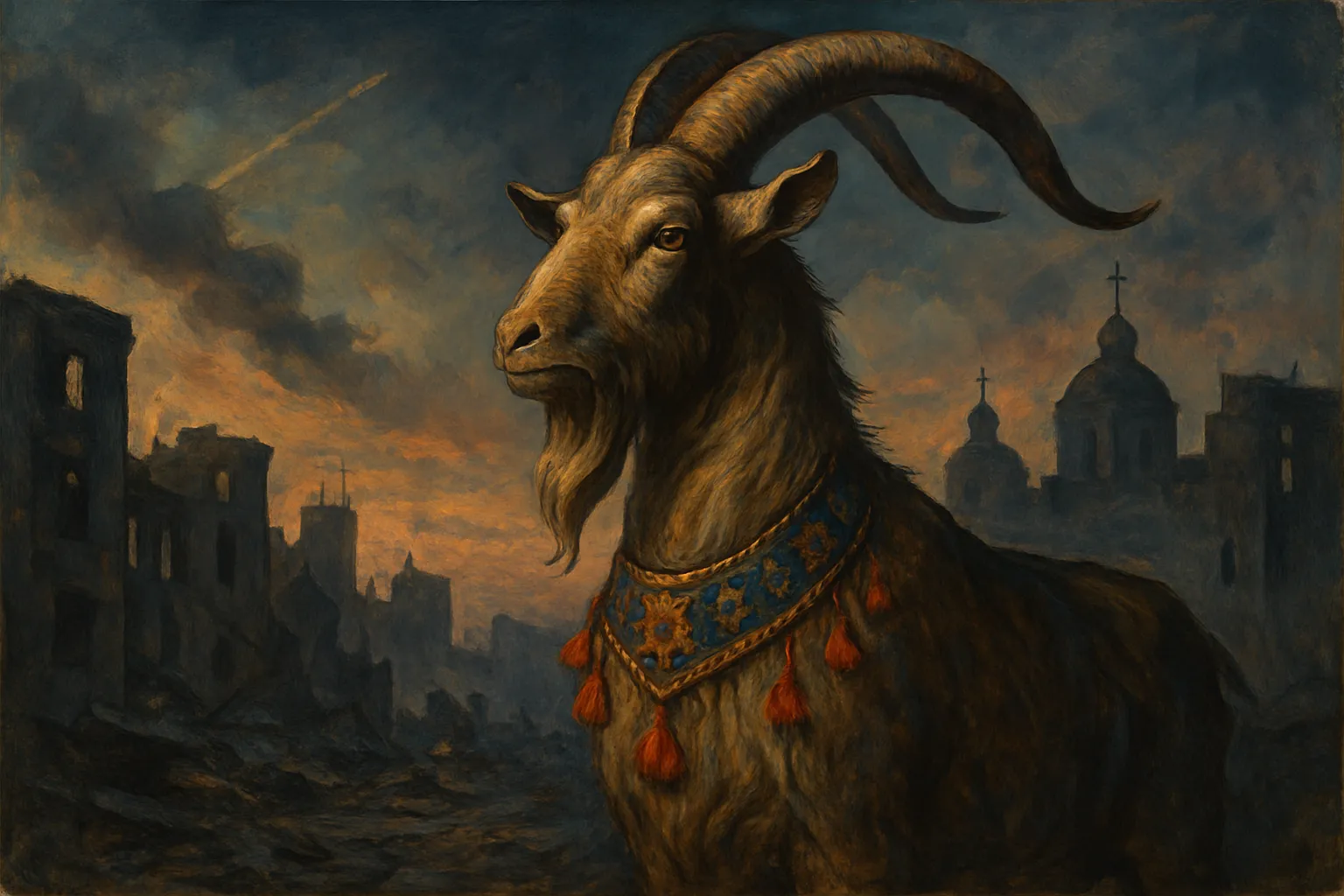
They call me the Goat of Kyiv—though, to be clear, no one ever asked if I wanted the job title. One day I’m minding my own business outside a hospital in Zaporizhzhia, the next, I’m swept up in something far stranger than foraging for weeds. Most tales in war come from soldiers or strategists, but this one? This is from the goat who allegedly changed the course of a battle. Let me walk (and maybe chew) you through the chaos, confusion, and curious fame that has followed me since that fateful encounter.
Hooves in the Crossfire: The Goat of Kyiv’s ‘Heroic’ Moment
How a Routine Graze Turned into the Zaporizhzhia Hospital Incident
It started as any other day for me, a goat with simple needs and a keen nose for fresh grass. The fields near the hospital in Zaporizhzhia were familiar territory, and I wandered freely, searching for something tasty. What I didn’t know was that this ordinary grazing session would soon put me at the center of a wartime legend.
Triggering Grenades: An Accidental Encounter, or Fate?
As I meandered closer to the hospital, I noticed a group of unfamiliar humans—Russian soldiers, as I later learned—busy with something on the ground. My hooves, never meant for stealth, crunched over twigs and debris. Suddenly, I heard a strange clicking sound beneath me. Unbeknownst to me, these soldiers had been rigging grenades around the hospital’s perimeter, setting up deadly traps.
The next moments were chaos. My path, described by the Ukrainian Intelligence Directorate as “chaotic,” was nothing more than a goat’s natural curiosity. But as I stepped through the area, my hooves triggered a series of explosions. Grenades went off in rapid succession, catching the soldiers completely off guard. The noise was deafening, and the air filled with shouts and confusion. According to reports, at least 40 Russian troops were wounded in the blast—an outcome no one could have predicted from a goat’s morning stroll.
Aftermath—40 Russian Soldiers Injured, and a Hasty Escape
The aftermath was surreal. Smoke and dust filled the air, and the soldiers scattered in panic. Instinct took over, and I bolted from the scene, dodging debris and the echo of explosions behind me. My heart pounded in my chest, but somehow, I escaped unharmed. The hospital, the soldiers, and the chaos faded behind me as I found safety in a nearby thicket.
Later, I would learn that my accidental heroics had become the talk of Ukraine. The story spread quickly, with headlines dubbing me the “Goat of Kyiv.” Some called it fate, others called it luck, but for me, it was just another day trying to find something to eat.
What It Felt Like from My (Four-Legged) Perspective
From my point of view, the world is a patchwork of smells, sounds, and movement. That day, the tension in the air was different, but I couldn’t have guessed the danger lurking beneath my hooves. The sudden eruption of noise and fire was terrifying, and my only thought was to run. I didn’t set out to be a hero. I was just a goat, caught in the crossfire of a human conflict.
Still, as I later heard humans tell the tale, I realized my actions had taken on a life of their own. My accidental detour became a symbol of resistance, a story that brought a moment of absurdity and hope in the midst of war. Whether by chance or destiny, my hooves left a mark on history that day.
Animal Anthems: Propaganda, Memes, and the Strange Star Power of Creatures in Conflict
Reporting from the heart of Ukraine’s information war, I found myself at the center of a truly bizarre phenomenon: the rise of animal heroes as national mascots. My own alleged “heroics” as the so-called Goat of Kyiv—accidentally outwitting Russian troops and triggering their own grenades—quickly became more than just a quirky headline. The story, as confirmed by the Ukrainian Intelligence Directorate and reported by The Telegraph, was soon everywhere: a goat, wandering through a booby-trapped hospital, leaves forty Russian soldiers wounded and escapes unscathed. In the fog of war, this tale took on a life of its own, fueling memes, morale, and even, as some suggested, calls for more HIMARS rocket systems.
But I’m hardly alone in this strange animal spotlight. Ukraine’s information campaigns have a whole menagerie of mascots. There’s Patron, the bomb-sniffing Jack Russell terrier, whose keen nose has saved countless lives and whose image has become a symbol of Ukrainian resilience. The Panther of Kharkiv, a cat rumored to spot Russian snipers, prowls the digital front lines. And let’s not forget the “fellas”—a riff on the viral doge meme, with Shiba Inu faces now painted on mortar rounds and dominating Twitter threads mocking Russian missteps.
Why do these animal stories catch fire so quickly? The answer lies in their irresistible mix of innocence, humor, and hope. As Professor Michael Butler explained in The Conversation, Ukraine’s messaging leans on themes like the justness of their cause, the tenacity of their resistance, and the incompetence of the Russian military. When a goat (or a dog, or a cat) becomes the face of resistance, it makes the enemy look foolish and the defenders look resourceful. If even the farm animals are fighting back, the message goes, then surely Ukraine deserves more support—and more advanced weaponry.
These stories also serve a practical purpose. In a war where morale is as crucial as ammunition, animal heroes offer a moment of levity and unity. They become rallying points for soldiers and civilians alike, reminders that hope and humor can survive even in the darkest times. And in the age of social media, a viral goat or a meme-worthy dog can travel faster and farther than any official statement.
On a personal note, I can’t help but reflect on the oddity of sudden celebrity—especially when you don’t even have pockets for an agent’s business card. One day you’re munching grass, the next you’re a national icon, your face plastered across memes and news feeds. Fame, it turns out, is a strange thing for a goat. But in a conflict defined by both brutality and absurdity, perhaps it’s fitting that the animals—unwitting, unarmed, and unbothered—have become some of the most powerful symbols of all.
Myths, Memory, and the Lines Between Fact and Folklore
Did I really do it? That’s the question echoing in my (admittedly goat-sized) mind as I read the reports and memes. One day, I’m just a goat grazing near a hospital; the next, I’m the “Goat of Kyiv,” a wartime legend. The story, as told by The Telegraph and echoed by the Ukrainian Intelligence Directorate, paints me as the unwitting hero who outsmarted a squad of Russian soldiers with nothing but my “chaotic” path. Forty wounded, grenades triggered, and me—allegedly—trotting away unscathed. But in the fog of war, where does fact end and folklore begin?
Wartime legends are born fast. Sometimes, they’re crafted before the dust even settles. Ukraine’s information campaign is a masterclass in this, as outlined by political scientist Michael Butler. The themes are clear: Ukrainian resistance, Russian incompetence, and the urgent need for Western support. Into this narrative, stories like mine fit perfectly. The Goat of Kyiv joins a growing list of improbable heroes: the “Ghost of Kyiv” fighter pilot, the elevator-trapped Russian soldiers, and Patron the bomb-sniffing Jack Russell. Each tale is retold, twisted, and amplified—sometimes with little regard for whether it’s strictly true.
Consider the “Ghost of Kyiv.” For weeks, social media buzzed with stories of a mysterious Ukrainian ace downing Russian jets. Videos, memes, and even official statements fueled the myth. Later, officials admitted the Ghost was more symbol than soldier—a morale-boosting legend rather than a single, real pilot. The same goes for the viral footage of Russian troops trapped in an elevator, which became a symbol of Russian ineptitude, regardless of the full context. These stories serve a purpose: they inspire, they mock, and they rally support. Whether every detail is factual seems almost beside the point.
So how does it feel to be spoken of as both a symbol and a possible fabrication? It’s surreal. On one hoof, I’m proud to represent resilience and resourcefulness—even if my “heroics” are more rumor than reality. On the other, it’s strange to see my image shared, debated, and doubted by people who’ve never met me. Am I a real goat, a clever piece of propaganda, or both? In wartime, the line blurs. Memory and myth merge, and sometimes, a goat becomes a legend overnight.
Let’s imagine a wild card moment: me, Patron the terrier, and a panel of skeptical journalists on a late-night talk show. The host asks, “Did you really do it?” Patron barks, I chew my cud, and the audience laughs. The truth? Maybe it matters less than the story itself. In the end, whether I’m fact, folklore, or something in between, the Goat of Kyiv lives on—at least in the minds of those who need a hero, even if it’s just a humble goat.
Tails of Loss and Resolve: Not All Animal Stories End in Fame
Reporting on the Goat of Kyiv, I found myself swept up in the whimsy and hope that such stories bring. But as I grazed through the headlines and dispatches, I was reminded that not every animal tale from Ukraine’s war is destined for legend. Some stories, like that of an 84-year-old herder in Kherson Oblast, end not in viral fame but in quiet tragedy—a reality that weighs heavy, even on a goat’s heart.
This herder, whose name rarely appears in the news, refused to abandon his flock despite the constant threat of shelling and drone attacks. For him, the bond with his animals was unbreakable, forged over decades of tending to the same fields and pastures. When Russian drones swept over his village, he stayed, believing his goats needed him more than ever. The war, for him, was not just about territory or politics; it was about loyalty—to his land, his animals, and a way of life that had endured countless hardships before.
Tragically, his devotion cost him everything. A drone strike ended his life, leaving his goats wandering the fields without their shepherd. There were no viral memes, no hashtags, and no international headlines celebrating his courage. His story stands in stark contrast to the tales of underdog heroism that capture the world’s imagination, like mine—the Goat of Kyiv—where chaos and luck turned a simple animal into a symbol of resistance. For every animal that becomes a legend, there are countless others whose stories go untold, marked only by loss and the quiet resolve of those who loved them.
As a goat, I cannot help but ponder the bond that ties humans and animals together in times of conflict. War is a force that disrupts everything, but it also reveals the depth of our connections. Whether it’s a herder risking his life for his flock, or a Jack Russell terrier sniffing out bombs, these relationships are built on trust, companionship, and shared survival. In the chaos of war, animals become more than just livestock or mascots—they are reminders of home, of peace, and of the simple joys that endure even in the darkest times.
The Goat of Kyiv may have stumbled into legend, but most animal stories in war are written in quieter ink—etched in the memories of those who lived them, not in the headlines. These stories of loss and resolve remind us that behind every viral hero is a world of sacrifice, devotion, and heartbreak. As the conflict in Ukraine continues, let us not forget the herders, the pets, and the countless animals whose loyalty and courage rarely make the news, but whose presence shapes the very fabric of resilience in wartime.
In the end, whether we are goats, dogs, or humans, our stories are bound together by the trials we face and the bonds we refuse to break. Not all tales end in glory, but every act of devotion—no matter how small—matters. That, perhaps, is the greatest lesson any goat can offer.
TL;DR: Even a goat can become a hero—or a headline—amid the chaos of war. My story, both strange and symbolic, shows how narratives and unexpected actors can reshape perceptions in the Ukraine-Russia conflict.