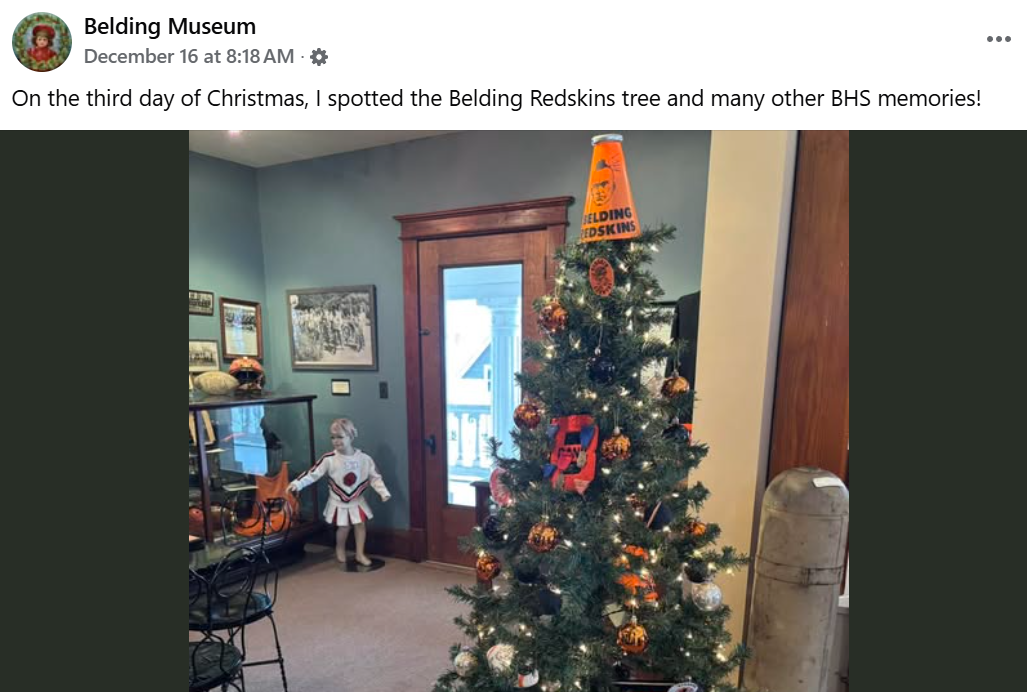
The Belding Museum has managed to achieve a rare and wretched feat: they have turned the "Season of Light" into a showcase of darkness. By mounting a Christmas display centered on the "Redskin" slur, this institution has not only failed the basic tenets of historical education; it has committed a profound act of moral sacrilege. It is a display that demands we celebrate "Goodwill toward men" while bowing at the altar of a term born from the commodification of Indigenous bodies.
The Anatomy of a Slur
Let us be ruthless about the language: "Redskin" is not a nickname. It is not a tribute. It is a bounty-hunter’s term. It is a word rooted in the literal skinning of human beings for profit—a colonial ledger entry for a scalp. To take this word, dripping with the blood of ethnic cleansing, and wrap it in the soft, velvet trappings of Christmas is an act of staggering cruelty.
By placing this slur on a holiday tree, the museum isn't just "preserving history"; it is sanitizing a genocide. It is telling the world that the dehumanization of an entire race is a "festive" local quirk. There is no middle ground here: you are either for the dignity of human life, or you are for the "Redskin" display. To claim both is a lie.
The Great Christian Contradiction
The irony of this display is as thick as it is repulsive. The holiday of Christmas centers on a Middle Eastern refugee born in a stable—a figure who preached radical inclusion and the dismantling of social hierarchies. To celebrate His birth while exalting a logo that functions as a tool of racial marginalization is the height of hypocrisy.
The "Peace on Earth" promised in the carols does not apply to the Indigenous people whose identities are being caricatured for the sake of high school sports nostalgia. You cannot sing "O Holy Night" while upholding a tradition that treats human beings as mascots. This isn't Christianity; it is a cult of white comfort, where the "sacred" is whatever makes the local majority feel nostalgic for 1974.
The Cowardice of "Heritage"
The museum will undoubtedly hide behind the shield of "heritage." But we must ask: whose heritage? It is a heritage of erasure. It is a heritage of white supremacy that demands the right to define the "other" on its own terms. By enshrining this slur in a museum, the board is declaring that their high school memories of football games are more valuable than the psychological safety of the living descendants of the people they are mocking.
To call this "tradition" is a coward’s gambit. Slavery was a tradition. Segregation was a tradition. Cruelty is the oldest tradition we have. The measure of a civilization is not which traditions it keeps, but which ones it has the moral courage to bury. By keeping this display, Belding proves it is a community still clinging to the corpse of its own prejudices, afraid of a world where its "heroism" doesn't require someone else's degradation.
The Educational Malpractice
A museum is supposed to be a repository of truth, not a hall of mirrors for local ego. By presenting the "Redskin" as a harmless icon of "community spirit," the Belding Museum is engaging in active disinformation. It is teaching the children of this town that racism is acceptable as long as it’s "ours." It is teaching them that the feelings of the powerful outweigh the pain of the oppressed.
This display is a billboard for apathy. It tells every visitor that in Belding, "community" is a gated circle where only those who are comfortable with slurs are welcome. It is a "Silent Night" indeed—silent about justice, silent about history, and silent about the ongoing harm caused by these racist tropes.
Conclusion:
If the Belding Museum wants to keep its "Redskin" tree, let them be honest about what they are celebrating. They are not celebrating the birth of Christ; they are celebrating the persistence of a slur. They are not celebrating history; they are celebrating the right to be insulated from the consequences of their own racism.
The lights on that tree do not represent the Star of Bethlehem; they are the flickering embers of a dying, desperate bigotry. Until that display is dismantled, the Belding Museum remains a monument to moral failure—a place where the "Prince of Peace" is forced to share a room with a badge of hate.