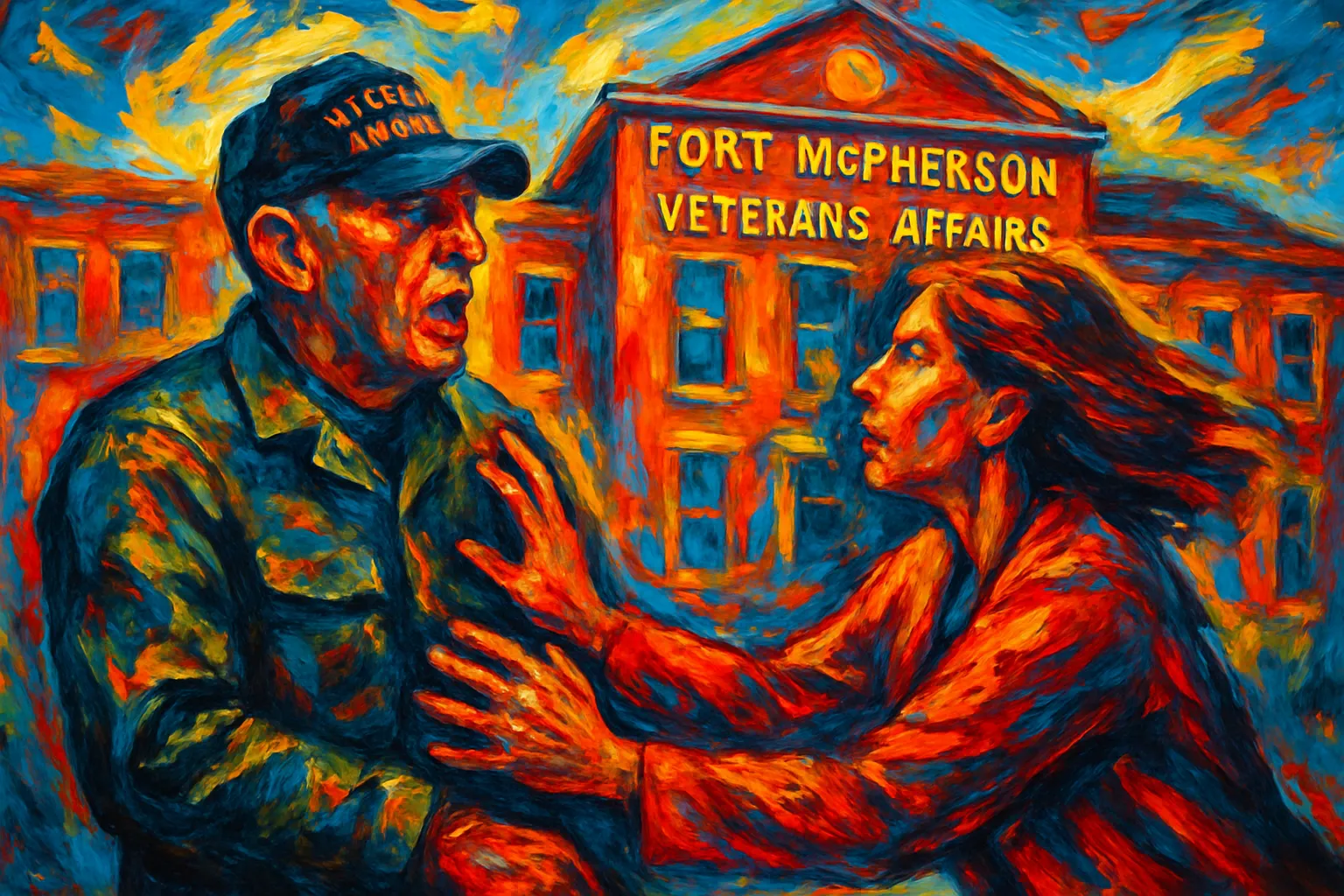
Is an institution ever truly interested in the individual, or only in its own survival? The footage from April 28, 2022, at Atlanta's Fort McPherson VA Clinic does not simply show a brutal assault—it lays bare the indifference of bureaucratic machinery when a single life is disrupted. Having spent my share of hours fighting paperwork and hospital hallway mazes, I know the feeling: you’re just another file for them. But when someone like Lawrence Gaillard Jr. attacks a Vietnam veteran under the eye of the system itself, we glimpse the true priorities of ‘public service’—control, not care.
The Incident: When State Power Becomes Personal Violence
On April 28, 2022, a shocking act of violence unfolded inside the Fort McPherson VA Clinic in Atlanta, Georgia. The victim, Phillip Webb, a 73-year-old Vietnam veteran, had arrived at the clinic for a routine discussion about an upcoming hernia surgery. What should have been a standard medical appointment quickly turned into a harrowing example of personal violence wielded by a representative of state power.
The assailant, Lawrence F. Gaillard Jr., was not a stranger to the clinic or its patients. As a patient advocate employed by the Department of Veterans Affairs, Gaillard’s role was to support and assist veterans navigating the VA system. Instead, surveillance footage obtained by WSB-TV captured Gaillard violently attacking Webb after Webb informed him he needed to use the restroom. The video evidence is both clear and disturbing: Gaillard grabs Webb, chokes him, slams him against a wall, throws him to the ground, and then delivers multiple kicks to Webb’s head before leaving the room.
“He was Mike Tyson-ing me there. I’m just stunned. I don’t know what to say,” Webb later told reporters, his words underscoring the disbelief and trauma inflicted by someone entrusted with his care.
The brutality of the attack, caught on camera, left little room for ambiguity. The footage circulated widely, sparking outrage among veterans, advocates, and the general public. The incident quickly became a focal point in discussions about the responsibilities and conduct of federal employees, especially those tasked with serving vulnerable populations like veterans.
Following the assault, the Department of Veterans Affairs responded by suspending Gaillard without pay. VA spokesman Terrence Hayes confirmed the suspension, stating, “The indefinite suspension is in place and we are unable to comment further as the matter remains under investigation.” However, records revealed that Gaillard continued to be employed by the VA until at least June 21, nearly two months after the attack. This delay in disciplinary action raised serious questions about the VA’s internal processes and the enforcement of federal regulations.
Federal law, specifically the “crime provision,” allows agencies to immediately suspend or remove an employee if there is reasonable cause to believe a crime punishable by imprisonment has occurred. In Gaillard’s case, despite his arrest and the severity of the charges, the process appeared to stall. Observers and advocacy groups questioned why the VA did not act more swiftly, especially given the clear evidence and the gravity of the assault.
The incident and its aftermath have been widely reported, with outlets like WSB-TV and Task & Purpose providing ongoing coverage. The story has resonated within the military and veteran communities, highlighting not only the vulnerability of those seeking care but also the potential for state authority to be misused in deeply personal and violent ways. The case remains under investigation, with many still seeking answers about how and why such an event could occur within the very institution meant to protect and serve America’s veterans.
Bureaucratic Delay: Why the Punishment Rarely Fits the Crime
The violent assault on Phillip Webb, a 73-year-old Vietnam veteran, inside the Fort McPherson VA Clinic was captured in clear surveillance footage and quickly circulated by Atlanta’s WSB-TV. The video left little room for ambiguity: Lawrence F. Gaillard Jr., a VA patient advocate, could be seen choking, slamming, and kicking Webb. Yet, despite the severity of the attack and the immediate public outcry, the Department of Veterans Affairs’ response was anything but swift.
VA’s Response: Indefinite Suspension, Delayed Action
In the days following the incident, the VA, represented by spokesman Terrence Hayes, confirmed that Gaillard had been placed on indefinite suspension without pay. However, records and reporting revealed that Gaillard remained employed at the VA for weeks after the assault. This delay was particularly striking given the clarity of the evidence and the gravity of the crime. The indefinite suspension only came after the video was made public and media attention intensified, raising questions about the VA’s internal processes and priorities.
Federal ‘Crime Provision’ Overlooked
Federal law provides agencies with a clear path for immediate action in such cases. The so-called “crime provision” allows for the instant removal or suspension of a federal employee if there is “reasonable cause to believe that the employee has committed a crime for which a sentence of imprisonment may be imposed.” This provision is designed to protect public trust and ensure swift accountability, even before the conclusion of judicial proceedings. In Gaillard’s case, despite his arrest and the existence of damning video evidence, this mechanism was not invoked until weeks later, if at all. The delay has sparked skepticism among observers and veterans’ advocates, who question whether the VA’s slow response was due to bureaucratic inertia or a reluctance to act without external pressure.
Public Scrutiny Drives Accountability
The VA’s official statements, including those from spokesman Terrence Hayes and apologies from Secretary Denis McDonough, only emerged after the incident became a matter of public record. This pattern—where institutions respond decisively only after media coverage and public outrage—has become familiar to many who follow federal agency scandals. The lack of immediate transparency and the slow pace of disciplinary action suggest a system more concerned with managing optics than enforcing accountability.
“He was Mike Tyson-ing me there. I’m just stunned. I don’t know what to say.” — Phillip Webb, victim of the Fort McPherson VA assault, speaking to WSB-TV
The case has drawn widespread attention, with outlets like Task & Purpose providing ongoing coverage and analysis. The delay in Gaillard’s suspension and the VA’s cautious public statements have fueled a broader debate about the effectiveness of federal disciplinary procedures and the agency’s commitment to protecting veterans. As the investigation continues, the lingering question remains: why did it take so long for the punishment to fit the crime?
Whose Values? Institutions, Apologies, and the Theatre of Accountability
When the violent assault of Phillip Webb at the Fort McPherson VA Clinic became public, the Department of Veterans Affairs moved quickly to issue an apology. VA Secretary Denis McDonough stated that the attack was “utterly inconsistent with our core values.” Yet, for Webb and many watching, such statements ring hollow. The gap between institutional values and individual experience is wide—and rarely bridged by words alone.
Institutional apologies, especially in the wake of scandal, serve a clear function: they are less about the harmed individual and more about protecting the organization’s reputation. In the case of Fort McPherson, the VA’s public response focused on distancing the agency from the actions of Lawrence F. Gaillard Jr., the employee who assaulted Webb. The message was clear: this is not who we are. But for Webb, who endured a brutal attack while seeking care, the apology did not erase the trauma or answer why the system allowed Gaillard to remain employed for weeks after the incident.
Symbolic Gestures and Real Consequences
The language of “core values” is a familiar refrain in the aftermath of institutional failure. Apologies are issued, investigations are promised, and the public is assured that this was an “exceptional” event. However, the facts revealed by WSB-TV and Task & Purpose tell a different story. Despite clear video evidence and the existence of a federal “crime provision” allowing immediate suspension, Gaillard continued working at the VA for nearly two months after the assault. The VA’s own spokesman confirmed only an “indefinite suspension,” with little explanation for the delay.
This pattern is not unique to the VA. Large bureaucracies often prioritize self-preservation over swift justice. The apology becomes a shield—protecting the institution’s image while real accountability lags. The focus on exceptionalism (“this is not what the VA is really like”) serves to isolate the incident, suggesting it is a rare deviation rather than a symptom of deeper systemic issues.
- Institutional Apologies: Often serve as public relations tools, not as mechanisms for real change.
- Delayed Accountability: Despite policies allowing immediate action, bureaucratic inertia and concern for due process can slow response times.
- Public Discourse: Media and officials emphasize the “exceptional” nature of such events, deflecting from broader questions about institutional culture.
The theatre of accountability—public apologies, press statements, and promises of reform—rarely delivers justice for individuals like Webb. Instead, it maintains the status quo, reassuring the public while leaving systemic problems unaddressed. In the halls of power, survival often comes first, and ethics a distant second.
“He was Mike Tyson-ing me there. I’m just stunned. I don’t know what to say.” — Phillip Webb, as reported by WSB-TV
As the Fort McPherson case shows, the values institutions claim to uphold are often tested not in their words, but in their actions—or lack thereof—when those values are most needed.
Wild Card: If Bureaucracy Had a Face—A Hypothetical Day as a File Number
Imagine walking into the Fort McPherson VA Clinic not as Phillip Webb, a Vietnam veteran with decades of service, but as a file number—one among thousands. In the halls of a system built to honor and protect, the reality can feel far different. The day begins with a long wait, the clock ticking as names are called and faces blur together. For many veterans, the sense of being seen as an individual is quickly replaced by the feeling of being processed—moved from one desk to another, each stop marked by paperwork, brief exchanges, and the quiet frustration of being just another case in a crowded system.
On April 28, 2022, this bureaucratic detachment took on a violent form. Surveillance footage from the clinic captured a shocking moment: Lawrence F. Gaillard Jr., a patient advocate, physically assaulted Webb, slamming him against a wall and kicking him repeatedly. The incident, which began over a simple request to use the restroom, exposed not only a failure of individual conduct but also the impersonal machinery that can define large institutions. In the aftermath, the VA’s response was slow and opaque. Gaillard remained employed for weeks after the assault, despite federal rules allowing for immediate suspension in such cases. The official explanation was silence—“the matter remains under investigation”—while the victim, and the public, waited for answers.
For veterans like Webb, the experience is a stark reminder that the promise of protection and respect can be lost in the shuffle. When something goes wrong, apologies and action often arrive only after the glare of media attention. The system’s instinct is to protect itself first, to manage the narrative before addressing the harm done to individuals. It is only when the story reaches the headlines—when the image of the agency is at risk—that the machinery of accountability lurches into motion.
This dynamic raises uncomfortable questions about the true purpose of power within state institutions. If the system exists to serve and safeguard those who have served, why does it so often respond only when its own reputation is on the line? The delay in Gaillard’s suspension, the lack of transparency, and the reliance on procedural language all point to a deeper problem: a culture where the individual is too easily reduced to a number, and where meaningful change is triggered not by duty, but by scrutiny.
The Fort McPherson VA incident is not just a story about one man’s suffering; it is a reflection of the uneasy relationship between veterans and the institutions meant to support them. As coverage by Task & Purpose and other outlets has shown, these stories matter—not only for the victims, but for the integrity of the system itself. Until bureaucracy learns to see the faces behind the files, the halls of power will remain uneasy, and the promise of protection will ring hollow for too many who have already given so much.
TL;DR: The attack on Phillip Webb at the Fort McPherson VA Clinic is a grim reminder that state institutions protect themselves before individuals, delaying action and obscuring responsibility when their own are at fault.